

Alternatives to Expensive Ergonomic Office Chairs
Table of Contents
- What Counts as an Alternative to Expensive Ergonomic Chairs
- Best Budget Office Chair for Working From Home
- Office Chair Alternatives for Small Spaces
- Kneeling Chair Benefits and Drawbacks
- How to Improve Posture in a Budget Office Chair
- Fit Guidance by Body Size and Work Setup
- Total Cost of Ownership and Refurbished Options
- Common Mistakes When Choosing a Budget Seating Solution
- Frequently Asked Questions
Last Updated: October 4, 2026
What Counts as an Alternative to Expensive Ergonomic Chairs
An alternative to expensive ergonomic office chairs is any seating solution or approach that reduces discomfort and supports productivity without the premium price tag of high-end ergonomic models. This includes budget office chairs with basic adjustability, non-traditional seating like balance balls or kneeling chairs, posture-support accessories, and workspace modifications that improve comfort.
The key distinction is that true alternatives address the core problem: supporting your body during long work sessions without forcing you to spend $800 to $2,000 on a single chair. Many professionals assume expensive ergonomic chairs are the only way to achieve proper support. In reality, comfort comes from multiple factors, seat height alignment, lumbar support, movement breaks, and posture awareness, not just the chair itself.
When evaluating alternatives to expensive ergonomic office chairs, consider what specific discomfort you're experiencing. Back pain, neck strain, and poor posture each have different solutions. Some people need a better chair. Others benefit more from a posture corrector, standing desk setup, or active seating option. The right alternative depends on your body, workspace, and actual pain points.

Best Budget Office Chair for Working From Home
A budget office chair balances basic ergonomic features, adjustable seat height, lumbar support, and breathable material, with an affordable price point, typically under $300. These chairs won't match premium models in customization or durability, but they deliver solid support for most work setups.
Look for these essential features in a budget chair:
- Adjustable seat height that aligns with your desk so your feet rest flat and elbows bend at 90 degrees
- Basic lumbar support (either built-in or via a cushion you add)
- Breathable mesh or fabric to prevent heat buildup during full-day sessions
- Tilt mechanism that locks at different angles, letting you recline slightly without sliding forward
- Stable base with smooth-rolling casters that won't wobble under normal weight
Budget chairs typically skip premium features like adjustable armrests, advanced recline systems, and high-end materials. That's acceptable if you're willing to make small adjustments, raising the seat with a cushion, using a separate lumbar pillow, or positioning your desk slightly higher.
The real advantage of a budget chair is cost recovery. If you spend $150 to $250 and it lasts 3-4 years, you've solved the seating problem without overcommitting capital. Many professionals buy a budget option first, then upgrade only if they identify specific comfort gaps.
Office Chair Alternatives for Small Spaces
Small workspaces demand seating that doesn't consume floor area. Expensive ergonomic chairs often have wide bases and high backs that dominate a compact room. Alternatives like compact task chairs, rolling stools, and wall-mounted options free up valuable space while still supporting work.
Active Seating Options
Active seating keeps your body engaged during work, promoting movement and core strength rather than passive sitting. These alternatives to expensive ergonomic office chairs range from subtle to unconventional.
A balance ball (also called a stability ball) forces your core muscles to stabilize your body, which can reduce slouching and improve posture awareness (pubmed.ncbi.nlm.nih.gov). The downside is fatigue, most people can't sit on a ball for a full 8-hour workday without discomfort. Use it for 1-2 hour blocks, then switch to a traditional chair.
A balance stool (or wobble stool) is a smaller, more controlled version. It tilts slightly in all directions, encouraging micro-movements that activate stabilizer muscles. Balance stools take up minimal space and work well in shared offices or small home setups. They're less tiring than balance balls but still require active engagement.
Sit-stand desk converters pair with any chair and let you alternate between sitting and standing throughout the day. Movement between positions reduces strain from static posture. This approach works especially well for small spaces because you're not adding a new chair, you're changing your seated position periodically.
Non-Traditional Seating Solutions
Kneeling chairs shift your weight forward, opening your hip angle and naturally aligning your spine. Your shins and knees support most of your weight, freeing your lower back from compression. They're excellent for short focused work, 30 minutes to 2 hours, but not ideal for all-day use.
Saddle seats (shaped like a horse saddle) position your legs in a more open stance, similar to kneeling chairs. They promote active sitting and take up minimal floor space. Like kneeling chairs, they work best in rotation with other seating.
Standing desk stools let you lean against a tall chair while standing, reducing leg fatigue without full-weight sitting. They're useful for people who alternate between standing and partial support throughout the day.
Kneeling Chair Benefits and Drawbacks
A kneeling chair is a specialized seating alternative where your body weight distributes across your shins and knees rather than your lower back. This positioning naturally tilts your pelvis forward and straightens your spine, reducing compression in the lumbar region.
Benefits:
- Opens hip angle, reducing lower back strain
- Encourages upright posture without conscious effort
- Takes minimal floor space
- Relatively affordable (typically $100-$250)
- Useful for desk work, reading, and focused tasks
Drawbacks:
- Uncomfortable for people with knee pain or joint issues
- Not suitable for 8-hour continuous use
- Requires padding for shin comfort
- May cause leg numbness during extended sessions
- Not ideal if you frequently adjust position or move around
Kneeling chairs work best as a rotation tool. Use one for 1-2 hours, then switch to a traditional chair or standing position. This variety reduces fatigue and prevents any single position from causing strain. They're particularly effective for people whose main complaint is lower back compression from traditional sitting.
How to Improve Posture in a Budget Office Chair
Good posture in a budget chair depends less on the chair itself and more on how you set it up and how you sit.
Start by adjusting your chair height so your feet rest flat on the floor and your knees bend at 90 degrees. Your elbows should also bend at 90 degrees when your hands rest on the keyboard.
Position your monitor at eye level, about an arm's length away. A monitor that's too low forces you to crane your neck downward. A monitor that's too high pulls your gaze upward.
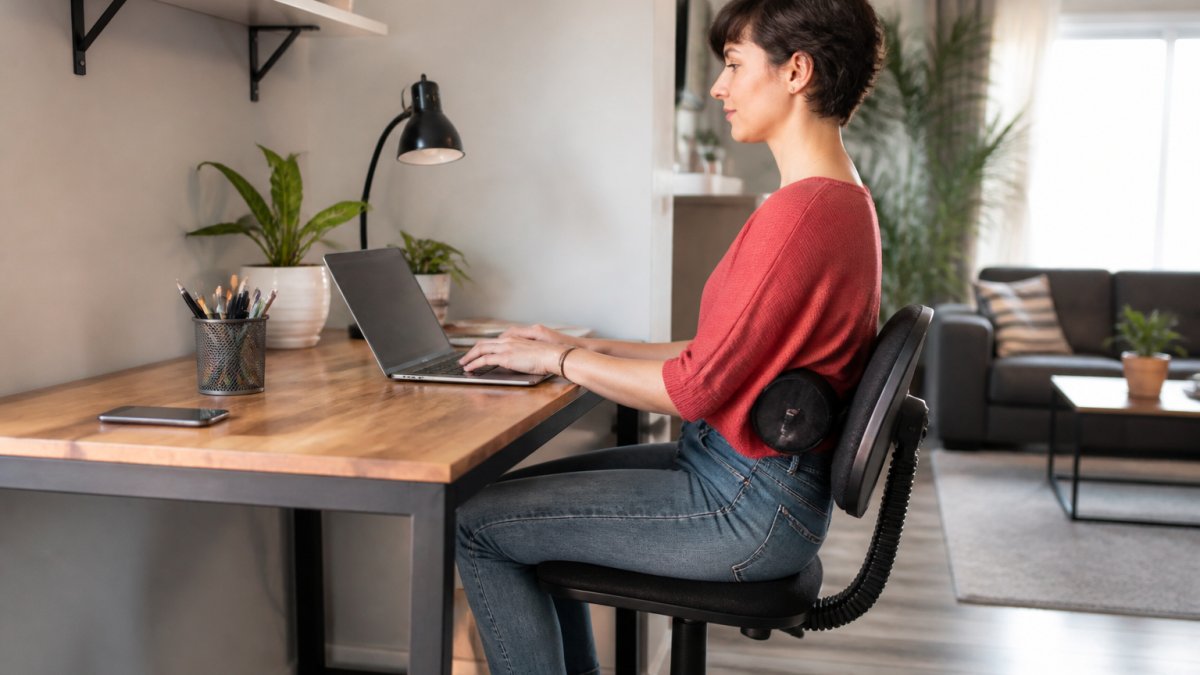
Use a lumbar support pillow or back cushion to fill the gap between your lower back and the chair. Even premium chairs often need supplemental lumbar support. A simple pillow costs $20-$50 and makes a significant difference.
Posture Corrector Back Brace Adjustable Back Support for Women and Men Shoulder →
Take movement breaks every 30-45 minutes. Posture problems worsen when you sit motionless for hours. Stand, stretch, walk around, or switch to a different seating position.
Consider adding a posture corrector back brace for additional support, especially if you have a history of back pain. The Posture Corrector Back Brace from ShopVerse.life ($64.48) provides adjustable support for natural spinal alignment and can be worn under clothing.
Fit Guidance by Body Size and Work Setup
Seating comfort is highly individual. What works for one person may not work for another, depending on height, weight, torso length, and leg length.
For taller people (over 6 feet): Standard chairs often feel cramped. Look for models with higher seat heights and deeper seats that accommodate longer legs. A tall person in a short chair creates poor posture.
For shorter people (under 5'4"): Many chairs sit too high, leaving your feet dangling. A footrest becomes essential. Alternatively, a kneeling chair or saddle seat may feel more natural because your weight distributes differently.
For heavier individuals: Check weight capacity ratings. Most budget chairs support 250-300 pounds. If you're above that range, reinforced options cost more but are necessary for safety and durability.
For small workspaces: Compact task chairs, rolling stools, and wall-mounted options minimize footprint. Active seating like balance stools or kneeling chairs also saves space because they're smaller and lighter.
For shared or flexible workspaces: Portable options like rolling stools or lightweight task chairs work better than heavy, fixed seating. You can move them easily and adjust to different desk heights.
Total Cost of Ownership and Refurbished Options
The upfront price of a chair is only part of the total cost. Consider durability, replacement timeline, and additional accessories when evaluating true cost.
A $200 budget chair that lasts 3 years costs roughly $67 per year. A $1,500 premium chair that lasts 10 years costs $150 per year. The math doesn't always favor expensive options, especially if your needs are modest.
Refurbished ergonomic chairs offer a middle path. Refurbished models, chairs returned, lightly used, or slightly damaged, cost 30-50% less than new while retaining most features. Retailers often provide warranties on refurbished items. If you want premium features without the full price, refurbished can be smart.
Budget for accessories too. A lumbar pillow ($25-$50), footrest ($30-$60), and monitor arm ($50-$100) can transform a basic chair into a comfortable setup for less than the cost of a mid-range ergonomic chair. Posture support tools like the Posture Corrector Back Brace ($64.48) add targeted relief without replacing your entire seating.
| Cost Category | Budget Chair Path | Refurbished Ergonomic Path | Premium New Path |
|---|---|---|---|
| Chair | $150-$300 | $750-$1,000 | $1,500+ |
| Accessories (lumbar, footrest, brace) | $100-$150 | $50-$100 | $0-$50 |
| Annual cost (5-year lifespan) | $50-$90 | $160-$220 | $300-$400 |
| Replacement frequency | Every 3-4 years | Every 7-10 years | Every 10+ years |
Refurbished options make sense if you want proven ergonomic features but can't justify premium pricing. Budget chairs with accessories suit people who prioritize cost control and don't mind replacing the chair sooner.
Common Mistakes When Choosing a Budget Seating Solution
The biggest mistake is buying a chair without testing how it fits your body and workspace. Online reviews help, but comfort is personal.
Another common error is ignoring seat height. A chair that doesn't align with your desk creates poor posture regardless of other features. Measure your desk height and test whether a chair's height range accommodates your proportions.
People often skip lumbar support because they assume a good chair includes it. Most budget chairs have minimal lumbar support. Adding a pillow is cheap and makes a real difference.
Underestimating movement is another trap. No chair, expensive or budget, is comfortable for 8 hours of continuous sitting. Build in standing, stretching, and position changes. A mediocre chair with regular breaks beats an expensive chair with zero movement.
Finally, don't assume your current pain requires an expensive solution. Back pain, neck strain, and poor posture often stem from desk height, monitor position, or posture habits, not the chair. Fix those first.
Finding comfort at your desk doesn't require spending a fortune on premium ergonomic chairs. At ShopVerse.life, we help you build a workspace that supports your body and your budget.
Frequently Asked Questions
What is the best budget office chair for work from home?
The best budget office chair balances lumbar support, adjustability, and durability without exceeding $300. Look for chairs with adjustable seat height, tilt mechanisms, and breathable mesh backs. Task chairs with armrests and a weight capacity matching your needs offer better value than gaming chairs repurposed as work seating. Test the seat depth and backrest angle before buying, comfort for 8-hour work sessions depends on these specifics, not brand recognition.
Can a kneeling chair or balance ball replace an ergonomic office chair?
Kneeling chairs and balance balls work best as supplements, not replacements. Kneeling chairs reduce lower back strain by tilting your pelvis forward, but they limit movement and aren't suitable for all-day use. Balance balls improve core engagement and posture awareness but lack back support and stability for focused work. Combine them with a budget desk chair for variety, switching between seating styles throughout the day prevents fatigue better than any single solution.
How can I make a budget office chair more comfortable?
Add a seat cushion to improve padding and reduce pressure points, especially on budget chairs with thin foam. Use a lumbar pillow or back brace, like the Posture Corrector Back Brace ($64.48), to support your lower spine and encourage proper alignment. Adjust seat height so your feet rest flat on the floor and elbows bend at 90 degrees. Position your monitor at eye level and keep your keyboard close to prevent reaching, which strains shoulders regardless of chair quality.
Is it worth buying a refurbished ergonomic chair instead of a new budget option?
Refurbished ergonomic chairs often deliver better long-term value than new budget models. A certified refurbished chair from a reputable seller costs 30-50% less than new while retaining superior materials, adjustability, and durability. Check the warranty, at least 1-2 years is standard for refurbished units. Budget new chairs typically wear out within 2-3 years, so a refurbished mid-range model may cost less over five years while providing better support throughout.