

Best Budget Alternatives to High-End Air Purifiers
Table of Contents
- Quick Comparison: Budget vs. High-End Air Purifiers
- How We Evaluated Budget Air Purifiers
- CADR Ratings Explained: What Actually Matters
- HEPA Filter Replacement Costs: The Hidden Expense
- Best Air Purifier for Allergies on a Budget
- Noise, Energy, and Real-World Performance
- Which Budget Air Purifier Should You Choose?
- Frequently Asked Questions
Last Updated: September 16, 2026
Quick Comparison: Budget vs. High-End Air Purifiers
The best budget alternatives to high end air purifiers deliver most of the filtration performance at a fraction of the lifetime cost. The gap between a $150 unit and a $900 unit is rarely filtration quality. It's sensors, app connectivity, and cabinet materials.
This guide breaks down what drives performance, where budget models cut corners, and how to pick a unit that lasts.
The uncomfortable truth most buying guides skip: filter media inside a budget purifier often comes from the same suppliers as premium brands. Paying four times more buys quieter operation and smarter automation, not cleaner air.
| Factor | Budget Models | High-End Models |
|---|---|---|
| True HEPA filter | Usually included | Included |
| CADR (small room) | 100-200 CFM | 200-350 CFM |
| Particle sensor | Basic or none | Laser-based |
| Noise at max fan | 50-60 dB | 40-55 dB |
| Filter cost per year | Lower | Higher |
| App control | Rare | Standard |
How We Evaluated Budget Air Purifiers
Budget air purifiers can be evaluated on five criteria: verified CADR ratings, three-year filter cost, measured noise output, build quality, and warranty terms. Sensor sophistication and app features often count least because they don't change how clean the air gets.
A purifier's real performance depends on air changes per hour in an actual room, not a lab chamber. Units can be weighed against the room sizes they claim to cover, then checked whether the fan could sustain adequate airflow at a sleep-friendly noise level.
The criteria that separated good budget units from bad ones:
- True HEPA certification, not "HEPA-type" or "HEPA-like" marketing language
- Published CADR numbers for smoke, dust, and pollen separately
- Filter replacement cycle and the cost of proprietary cartridges
- Noise decibel levels at each fan speed setting, not just the lowest
- Warranty length and whether replacement parts stay available
A common mistake is buying on room coverage claims alone. Manufacturers inflate square footage by assuming an 8-foot ceiling and one air change per hour, far below what allergy sufferers need.
CADR Ratings Explained: What Actually Matters
CADR (Clean Air Delivery Rate) measures how many cubic feet of filtered air a purifier delivers per minute, tested separately for smoke, dust, and pollen. Higher CADR means faster contaminant removal for a given room size.
Which number matters most depends on your goal: pollen and dust CADR for allergy relief, the smoke rating (usually the lowest of the three) for smoke removal.
A simple rule: match CADR to room square footage.
HEPA Filter Replacement Costs: The Hidden Expense
HEPA filter replacement costs are where budget and high-end purifiers diverge most sharply over time. A cheap unit with expensive proprietary filters can cost more across three years than a pricier unit with standard cartridges.
Budget purifiers typically use one of three filter setups:
- Pre-filter plus true HEPA plus activated carbon, the standard three-stage stack
- Washable pre-filter with replaceable HEPA, the cheapest long-term option
- Combined all-in-one cartridge, convenient but usually the most expensive to replace
A Three-Year Cost-to-Own Framework
You don't need a spreadsheet, just four numbers per model: purchase price, filter price, replacement interval, and any pre-filter cost. Multiply filter price by replacements within three years, add the purchase price, and you have a working total. The lower sticker price frequently loses.
A common pattern across budget models:
- Washable pre-filter + separate HEPA: lowest three-year total, because you replace only the HEPA layer and only when airflow drops
- Three-stage stack with separate layers: middle of the pack, and you can often swap generic carbon for the branded version
- All-in-one sealed cartridge: highest three-year total, because you discard carbon, pre-filter, and HEPA media together every cycle
How to Read Filter Pricing Before You Buy
Filter pricing is rarely printed on the product page. Find the replacement cartridge listing, check the stated replacement interval, and divide cartridge price by rated months for a monthly filter cost, the fairest way to compare a $150 unit against a $400 one.
The Repairability Overlay
Filter cost is only half the ownership story; the other half is whether the unit survives three years. Budget models with accessible fans and standard fasteners can be opened, cleaned, and repaired. Sealed units cannot, if a fan bearing fails, you replace the machine, and the filter savings you chased evaporate.
Best Air Purifier for Allergies on a Budget
The best air purifier for allergies on a budget is one with a true HEPA filter, a pollen CADR matched to your room, and a washable pre-filter. Those three features handle allergen reduction without the premium price of laser sensors and app control.
Noise, Energy, and Real-World Performance
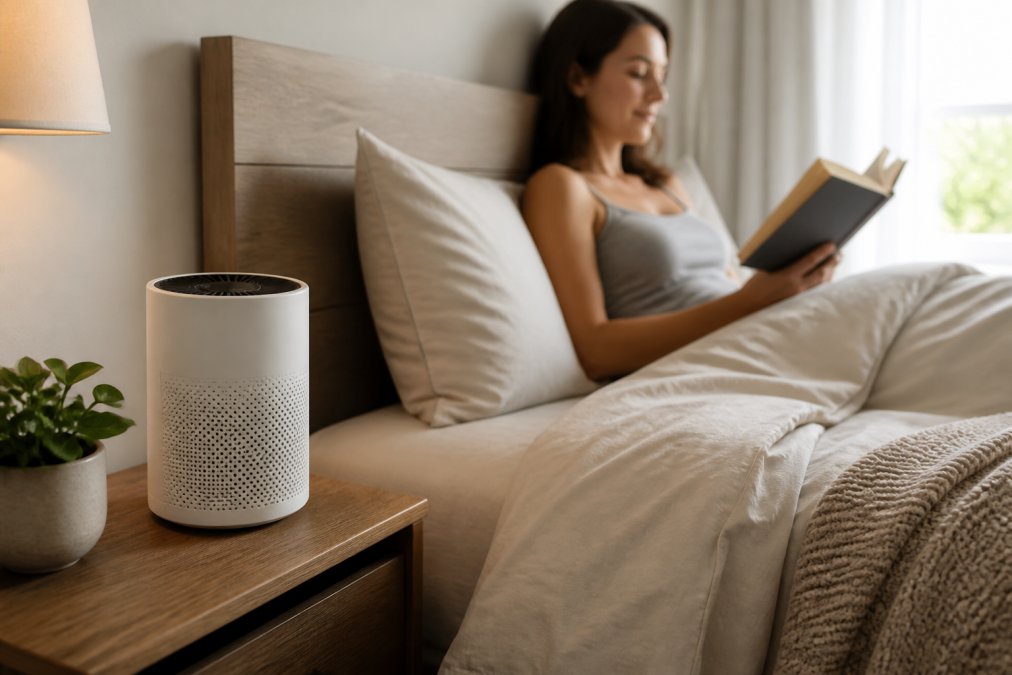
Noise decibel levels and power draw are the two specs budget shoppers overlook, and both shape whether you actually keep using the purifier. A unit that's too loud at night gets switched off, defeating its purpose. Treat published numbers as a starting point and verify the speed you'll actually run.
Why the Sleep Mode Number Is Misleading
The decibel figure printed for sleep mode is measured at the lowest fan speed, which also moves the least air. That's the trap. The number that matters is the decibel level at the speed that actually delivers your target CADR.
Energy Consumption in Real Terms
Energy consumption is a smaller factor than most buyers expect. A typical purifier draws 20 to 50 watts at medium speed, less per month than a single incandescent bulb left on, so efficiency shouldn't drive your decision. Where it matters is heat and motor longevity: a unit running hot at medium speed works harder than it should, shortening fan life.
Repairability: The Angle Most Guides Skip
Repairability is the angle almost no buying guide covers, and it's where budget models can beat premium ones. Units with accessible fans and standard filters are far easier to keep running than sealed premium models: a failed fan bearing means replacing a part, not the whole machine.
What to check before buying:
- Accessible fasteners: standard screws, not glued or clipped housings
- Published parts list: replacement fans, motors, or power supplies sold separately
- Warranty length and terms: a longer warranty on a budget unit signals the brand expects it to last
- Filter availability: standard cartridges or a healthy third-party aftermarket
Matching Performance to the Room
Real-world performance depends on air changes per hour in your actual room, not a lab chamber. A purifier rated for a large space runs quieter at your target CADR than a small unit pushed to maximum. If noise is your priority, buy one size up and run it on medium for the same filtration with less fan strain and longer service life.
Which Budget Air Purifier Should You Choose?
Here's a decision framework:
- Small room under 200 sq ft, allergy focus: prioritize pollen CADR and a washable pre-filter
- Large room over 300 sq ft: choose the highest smoke CADR you can afford, run it on medium
- Bedroom, noise-sensitive: check decibel levels at medium speed, not just sleep mode
- Pet household: insist on an activated carbon layer for odor and volatile organic compounds
- Long-term value: pick a model with widely available, separately replaceable filters
For readers who'd rather skip the spec-hunting, ShopVerse.life curates home and wellness products, including air purifiers, with fast shipping, secure payment, and a money-back guarantee.
Frequently Asked Questions
Are cheap air purifiers worth buying?
Yes, if you check the specs. A budget air purifier with a true HEPA filter and a CADR rating matched to your room size cleans air as effectively as a high-end unit. What you give up is smart home integration, air quality sensors, and quieter operation at high fan speeds. For allergen reduction and dust capture, a well-chosen budget model covers the essentials at a fraction of the cost.
Do budget air purifiers effectively remove smoke and allergens?
A budget unit with true HEPA filtration captures 99.97% of particles at 0.3 microns, which includes smoke particles, pet dander, and pollen. The key is matching the CADR rating to your room size. If the CADR is too low for the space, the purifier will not cycle enough air to make a measurable difference. Check the smoke CADR specifically if wildfire smoke is a concern.
How often do I need to replace filters on affordable air purifiers?
Most budget air purifiers need a new HEPA filter every 6 to 12 months, depending on use and air quality. Pre-filters can be vacuumed monthly and often last longer. Activated carbon filters typically need replacing every 3 to 6 months. Factor these costs into your total: a unit that costs less upfront but needs frequent filter changes may cost more over two years.
What is the difference between HEPA and non-HEPA budget purifiers?
True HEPA filters trap 99.97% of airborne particles at 0.3 microns. Non-HEPA units, sometimes labeled HEPA-type or HEPA-like, capture far fewer particles and are not tested to the same standard. If you are buying for allergies, asthma, or smoke, always confirm the packaging says true HEPA or HEPA H13. A cheap non-HEPA unit is not a budget alternative to a high-end purifier; it is a different product.
Picking a budget purifier that actually performs means cutting through inflated coverage claims and locked-in filter costs. ShopVerse.life carries a curated selection of home wellness products backed by 24/7 online support and secure payment, so you can compare vetted options in one place. Browse the collection and find a purifier that fits your room and your budget.