

How to Spot Fake Wellness Product Reviews in 2026
Table of Contents
- Why Fake Wellness Reviews Are Booming in 2026
- Red Flags of Fake Health Product Reviews
- Tools to Detect Fake Online Reviews
- How to Avoid Buying Counterfeit Supplements Online
- AI-Generated Influencers and Hyperrealistic Ads
- How to Report Fake Reviews and Unauthorized Sellers
- Conclusion
- Frequently Asked Questions
Last Updated: September 26, 2026
Why Fake Wellness Reviews Are Booming in 2026
Fake wellness reviews have become one of the fastest-growing problems in online shopping, and the reason is simple: health products sell on trust, and trust is easy to fake. This guide from ShopVerse.life breaks down how to spot fake wellness product reviews before you waste money on a product that never had a real customer behind it.
The Federal Trade Commission has repeatedly warned that deceptive reviews and misleading health claims are a top consumer protection priority. According to the FTC's guidance on fake and deceptive reviews, paying for reviews or suppressing honest negative ones can violate federal law.
Wellness is a perfect target. A supplement either works or it doesn't, and most buyers can't tell the difference in a week.
So scammers flood listings with glowing five-star posts. Here's how to catch them.
Red Flags of Fake Health Product Reviews
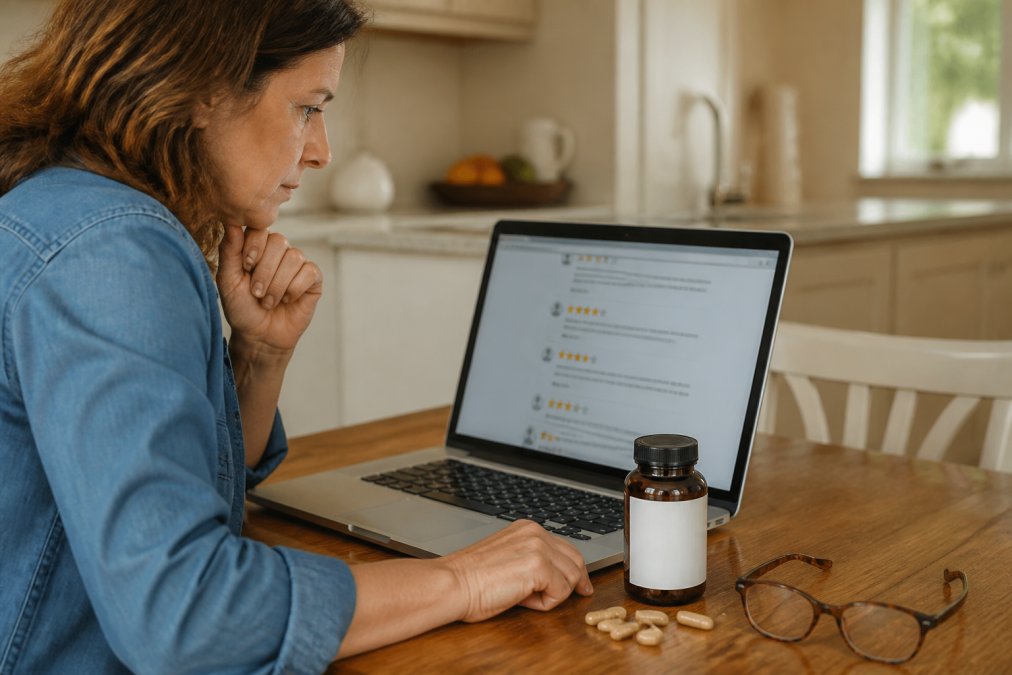
The clearest red flags of fake health product reviews are bursts of five-star ratings, vague praise, and reviewers who never mention a single downside. Real people complain. Fakes almost never do.
Watch for these patterns:
- A sudden flood of reviews on the same day
- Every review uses nearly identical phrasing
- No verified purchase badge on any review
- Reviewers with only one review in their entire history
- Claims that a product "cured" a serious condition
Language Patterns That Give Fakes Away
Fake reviews lean on hype words. Look for phrases like "miracle," "life-changing," and "doctor-recommended" with no source behind them.
Real reviews get specific. They mention taste, size, shipping time, or how many weeks it took to notice anything.
If a review reads like ad copy, treat it like ad copy.
Reviewer Profiles and Verified Purchase Signals
Click the reviewer's name. A real profile has history, other reviews, and a mix of ratings.
A profile with one review, posted the same week the product launched, tells you plenty.
Look for the verified purchase tag.
Tools to Detect Fake Online Reviews
Tools to detect fake online reviews range from free browser extensions to review-analyzer sites that scan for repeated text and suspicious timing. None are perfect, but they cut your research time fast.
A practical approach:
- Paste the review text into a search engine and check for copy-paste matches.
- Use a browser extension that flags review bursts and unverified posts.
- Cross-check ratings on at least two independent sites.
- Check the FTC's consumer advice on spotting rip-offs for current scam alerts.
Browser Extensions and Review Analyzers
Review-analyzer extensions grade sellers and highlight patterns humans miss, like a spike of reviews from new accounts.
How to Avoid Buying Counterfeit Supplements Online
You avoid buying counterfeit supplements online by sticking to authorized resellers, checking batch numbers, and inspecting packaging before you trust a listing. Counterfeits often copy the label but skip the quality controls, and in the supplement category, that can mean fillers, undeclared pharmaceuticals, or simply a bottle of rice flour.
The Visual Identification Guide: Real vs. Counterfeit Packaging
Counterfeiters are good at copying the front of a label. They are usually sloppy about everything else. Compare the bottle in your hand, or the listing photos, against the brand's official product page and look for these differences:
- Font and spacing. Real labels use consistent kerning. Fakes often have slightly different letter spacing, a stretched logo, or a registered trademark symbol that is the wrong size.
- Color drift. A red that is slightly orange, or a green that is slightly muted, is a common giveaway when a counterfeit is printed from a photo rather than the original file.
- Supplement Facts panel. Check the units. Real labels use "mcg" and "mg" correctly. Fakes frequently mix them up, drop the percent daily value column, or list an ingredient the brand does not actually use.
- Lot number and expiration date. On real products these are stamped or ink-jetted in a consistent font, often slightly unevenly. On counterfeits they are frequently printed as part of the label artwork, perfectly aligned, same ink as everything else.
- Seals and shrink wrap. A broken or missing induction seal under the cap is a hard stop. So is shrink wrap that looks heat-gunned rather than factory-applied.
- Bottle and cap. Compare cap size, thread count, and bottle weight against a bottle you have bought before from a trusted source. Counterfeiters often reuse a generic bottle that is a few grams lighter.
Verifying Authorized Sellers and Batch Numbers
An authorized reseller is a seller the brand has approved to stock its products. If a listing is not on that list, you are taking a risk, even if the seller has a high rating, because ratings can be bought.
How to verify:
- Go to the brand's official website and look for a "Where to Buy" or "Authorized Retailers" page. Many brands list approved marketplaces and storefronts by name.
- On a marketplace, check whether the listing says "Ships from and sold by [Brand]" or "Sold by [Brand]." If a third-party seller is fulfilling the order, the chain of custody is broken.
- Call or email the brand's customer service with the seller name. Most will confirm or deny authorization in a day.
AI-Generated Influencers and Hyperrealistic Ads
AI-generated influencers now push supplements through hyperrealistic ads that look like real testimonials. These fake faces never existed, and neither do their results. The FTC has warned that using fake or AI-generated endorsers to promote health products can count as a deceptive practice under its endorsement guides, because a fabricated person cannot have genuinely used the product.
How to Tell an AI Influencer From a Real One
Look at the whole profile, not one post:
- Hands and teeth. AI image models still struggle with fingers, jewelry, and the gaps between teeth. Zoom in. Count the fingers. Look for a ring that melts into the skin.
- Backgrounds. Doorways that lead nowhere, text on signs that is almost-but-not-quite letters, and reflections that do not match the subject are common tells.
- Consistency across time. A real creator has years of posts, tagged friends, and candid photos. An AI persona often has a shallow archive, all posted within a few weeks, all professionally lit.
- Voice and lip-sync. AI video often has a slight lag between mouth movement and audio, or a voice that never varies in pace or breath.
- The link in bio. Follow it. If it points to a single-product landing page with a countdown timer and no company address, treat the whole account as an ad, not a person.
Verify the Claim, Not the Face
Even a real influencer is not a medical source. When a video claims a supplement "reverses" a condition, look for the underlying evidence rather than the presenter:
- Search the ingredient name plus "clinical trial" on PubMed or Google Scholar. If the only studies are in cells or mice, the human claim is not supported.
- Check whether the brand is named on the National Institutes of Health's Office of Dietary Supplements fact sheets, which summarize what the evidence actually shows for common ingredients.
- Look for a structure-function disclaimer on the label. In the U.S., supplement claims cannot say a product treats, cures, or prevents a disease, only that it "supports" a structure or function. A brand that ignores this line is signaling it does not care about the rules.
How to Report Fake Reviews and Unauthorized Sellers
You report fake reviews and unauthorized sellers by filing with the platform and the FTC. Reporting protects other shoppers and helps regulators track patterns.
Where to report:
- The marketplace's own "report review" button
- The FTC's ReportFraud portal
- Your state attorney general's consumer protection office
- The manufacturer, if a counterfeit is involved
Conclusion
Fake reviews and counterfeit wellness products will keep adapting, especially as AI makes fakes harder to spot. The defense is a routine: check the seller, verify the batch number, read the one-star reviews first, and report what looks wrong.
Frequently Asked Questions
How to tell if product reviews are fake?
Look for clusters of five-star reviews posted within a short window, generic praise with no product specifics, and reviewer profiles with only one or two total reviews. Check whether the review mentions a verified purchase badge. Fake wellness reviews often repeat the same phrases across multiple products. Cross-reference claims with peer-reviewed research or third-party testing results before trusting them.
How do I tell if my supplements are fake?
Check the batch number and expiration date on the label against the manufacturer's website. Buy only from authorized resellers, not third-party marketplace sellers. Look for third-party testing seals from labs that verify label accuracy. If the price is dramatically lower than retail or the packaging has spelling errors, treat it as a red flag. Counterfeit supplements may contain none of the listed ingredients or dangerous substitutes.
Are there tools to detect fake reviews?
Yes. Browser extensions like Fakespot and ReviewMeta analyze review patterns and assign credibility grades. Google's review analysis tools flag suspicious activity on business listings. For supplements, check the FDA's warning letter database and recall lists. These tools to detect fake online reviews work best when combined with manual checks like reading reviewer history and looking for verified purchase tags.
What are the red flags of a fake wellness testimonial?
Watch for medical miracle claims like 'cured my diabetes in a week' or 'lost 30 pounds without dieting.' Fake testimonials often use scare tactics about conventional medicine, lack specific details about dosage or timeframe, and appear alongside hyperrealistic ads featuring AI-generated influencers. Legitimate testimonials describe gradual results and include caveats. If a review promises a quick fix with no side effects, it is almost certainly fabricated.