

Is a Digital Meat Thermometer Worth Buying?
Table of Contents
- What a Digital Meat Thermometer Actually Does
- USDA Internal Temperature Guidelines: The Safety Standard Behind the Purchase
- Digital vs Analog Meat Thermometer: Which One Earns Its Place
- How to Use a Meat Thermometer Correctly
- The Hidden Costs: Software Obsolescence, Privacy, and Repairability
- Who Gets the Most Value From a Digital Meat Thermometer
- Frequently Asked Questions
Last Updated: September 13, 2026
What a Digital Meat Thermometer Actually Does
A digital meat thermometer is a handheld electronic probe that measures the internal temperature of meat, poultry, and fish using a thermistor or thermocouple sensor, displaying the reading in seconds on a digital screen. This guide from ShopVerse.life covers whether that precision justifies the purchase.
That speed matters more than most shoppers realize. An analog dial thermometer can take 20-30 seconds to register a stable reading, while a quality digital probe settles in 2-5 seconds (fsis.usda.gov). For anyone cooking chicken, pork, or a holiday roast, that gap is the difference between checking once and checking five times.
Here's the practical case: the USDA's food safety guidance on safe minimum internal temperatures ties doneness to a number, not to color or juice clarity. A digital meat thermometer is the only tool that gives you that number reliably. Below, we'll break down who actually benefits, what the hidden costs look like, and where a cheap analog dial still makes sense.
USDA Internal Temperature Guidelines: The Safety Standard Behind the Purchase
The entire purchase decision rests on one fact: color, texture, and "juices running clear" are unreliable indicators of doneness. The USDA publishes specific safe minimum internal temperatures for each protein, and hitting them is what makes a thermometer worth owning.
Safe Minimum Internal Temperatures for Meat and Poultry
The USDA Food Safety and Inspection Service safe temperature chart lists the following minimums. Note that ground meats require higher temperatures than whole cuts because surface bacteria get mixed throughout during grinding.
| Protein | Safe Minimum Internal Temperature | Rest Time |
|---|---|---|
| Poultry (whole, parts, ground) | 165°F | None required |
| Ground beef, pork, veal, lamb | 160°F | None required |
| Whole cuts of beef, pork, veal, lamb | 145°F | 3 minutes |
| Fish and shellfish | 145°F | None required |
| Leftovers and casseroles | 165°F | None required |
Why Resting Time Matters After Cooking
Resting time is not a suggestion. During rest, carryover cooking continues raising the internal temperature by several degrees while juices redistribute through the meat.
Pull a whole cut at 145°F, rest it three minutes, and the final temperature climbs slightly higher. Skip the rest, slice immediately, and you lose moisture to the cutting board. A digital thermometer helps you pull at the right moment, then verify the carryover.
Digital vs Analog Meat Thermometer: Which One Earns Its Place
The honest answer is that these are two different tools with two different jobs, and the "worth it" question only makes sense once you know which job you are hiring for. Digital wins on speed, precision, and the ability to read thin cuts; analog wins on cost, zero maintenance, and the ability to sit in an oven for an hour without a battery dying.
Why Digital Reads Faster: The Sensor Mechanism
The speed gap is not marketing. It comes down to how each sensor converts heat into a number.
- Analog dial (bimetallic coil): Two bonded metal strips expand at different rates as they heat, and that expansion twists a needle. The coil has to physically warm up before the needle moves, which is why a dial can take 20-30 seconds to settle, and why it often keeps creeping after you pull it out.
- Digital thermistor: A small semiconductor bead changes electrical resistance as temperature rises. The change is near-instant, so a quality probe settles in 2-5 seconds.
- Digital thermocouple: Two dissimilar metal wires joined at a tip generate a tiny voltage proportional to temperature. Thermocouples are the fastest of the three, often under 2 seconds, and they tolerate the highest heat, which is why they dominate in grilling and smoking setups.
That mechanism difference is also why digital units hold accuracy across a wider range. A dial thermometer is typically most accurate in the middle of its scale and drifts at the extremes; a thermistor or thermocouple is calibrated across the whole range.
Side-by-Side Comparison
| Feature | Digital (Thermistor) | Digital (Thermocouple) | Analog Dial |
|---|---|---|---|
| Reading speed | 2-5 seconds | Under 2 seconds | 20-30 seconds |
| Typical accuracy | ±1°F | ±1°F or better | ±5-10°F |
| Heat tolerance | Moderate (check rating) | High | High |
| Battery | Required | Required | None |
| Calibration | Usually adjustable | Usually adjustable | Fixed or manual |
| Best for | Everyday cooking, poultry, roasts | Grilling, smoking, high-heat searing | Occasional use, oven leave-in, backup |
The Total-Cost Question
A dial thermometer costs less up front and never needs a battery, which makes it look cheaper on the shelf. Run the numbers over five years and the picture changes:
- A dial unit that reads ±10°F can push you to overcook a $40 roast to be "safe," or to undercook chicken and throw it back in the pan. Either outcome costs more than the thermometer.
- A digital probe with a replaceable battery and a replaceable probe can last a decade. A sealed digital unit with a non-replaceable battery is a disposable purchase.
- The cheapest digital probe is not automatically the best value. Models that cannot be calibrated against ice water will drift, and a drifting probe is worse than an honest dial because it gives you false confidence.
A common pattern among frequent cooks is to own both: a fast digital probe for spot-checking, and a cheap dial or leave-in oven thermometer as a backup that never needs charging.
The analog dial earns its place as a budget backup or a leave-in oven thermometer. For anything where a few degrees matter, poultry, pork, roasts, smoked brisket, digital is the better tool, and the price gap between a decent digital probe and a dial is small enough that the accuracy difference pays for itself on the first holiday meal.
How to Use a Meat Thermometer Correctly
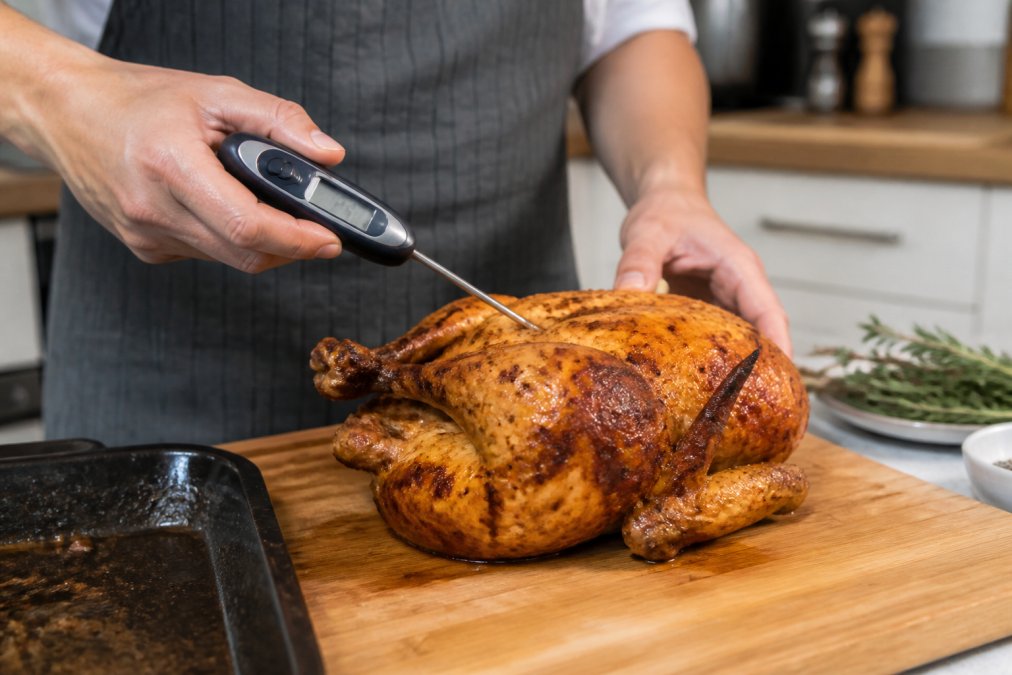
Getting an accurate reading is about placement, not pressure. The probe needs to reach the thermal center of the thickest part without touching bone, fat, or the pan.
Placement Tips for Accurate Readings
Follow these steps for a reading you can trust:
- Insert the probe into the thickest part of the meat, away from bone and fat
- Push to the thermal center, not all the way through
- Wait for the reading to stabilize, usually a few seconds on digital models
- Take a second reading in a different spot on large cuts like roasts or whole birds
- Wipe the probe with hot soapy water between raw and cooked checks
For thin cuts like burgers or chicken breasts, insert from the side to reach the center. For whole poultry, check the innermost thigh and the thickest part of the breast separately, since they cook at different rates.
The Hidden Costs: Software Obsolescence, Privacy, and Repairability
Most reviews stop at the sticker price. The three costs that actually determine whether a smart thermometer was worth buying show up two to five years later, and almost no competitor covers them. This section does.
Software Obsolescence: The 3-5 Year Cliff
App-connected thermometers depend on three things that can each disappear independently: the phone app, the firmware on the device, and the cloud service the app talks to. When any one of them stops being maintained, the "smart" features you paid a premium for stop working, even though the probe itself is fine.
The pattern is predictable:
- Years 1-2: App updates ship, new phone OS versions are supported, pairing works.
- Years 3-4: Updates slow. A new phone OS version may break pairing until a patch arrives, or may never be patched.
- Years 5+: The app is delisted, the cloud endpoint is retired, or the manufacturer exits the category. The thermometer still reads temperature as a basic probe, but guided cooks, temperature alerts, and history logging are gone.
Before buying, ask three questions: Does the thermometer work as a standalone probe with no app? Is the app required for basic temperature reading, or only for extras? Has the manufacturer shipped app updates in the last 12 months? A "yes" to the first two and a recent update history is the strongest signal that the device will still be useful in five years.
Privacy: What a Kitchen Thermometer Can Collect
A thermometer that only reads temperature has nothing to collect. A thermometer with an app and an account can collect more than most buyers expect:
- Account email and, in some apps, phone number
- Approximate location (often requested for "nearby recipes" or store features)
- Cooking history, what you cooked, when, and at what temperature
- Device identifiers and usage analytics
The trade is worth questioning because the benefit is small. A standalone probe gives you the same temperature reading with no account, no permissions, and no data leaving the kitchen. If you do want app features, check whether the app works without an account and whether location can be denied without breaking core functions.
Repairability: The Question That Separates a Decade From a Season
Many digital thermometers are sealed units. The battery is soldered in, the probe is not user-replaceable, and a failed display means the whole device is e-waste. A repairable model inverts every one of those:
- Replaceable battery, usually a coin cell or a standard AAA. This alone can double the useful life.
- Replaceable probe, probes fail first because they take the heat and the washing. A $10-$15 replacement probe keeps a $50 unit alive.
- Calibration access, a unit you can recalibrate against ice water can be trusted for years; a sealed unit that drifts cannot be fixed.
- Available parts, check whether the manufacturer sells replacement probes and batteries directly, not just through third-party listings that may dry up.
A Pre-Purchase Checklist
Run this before you buy any app-connected thermometer:
- Does it work as a standalone probe if the app disappears?
- Is the battery user-replaceable?
- Is the probe user-replaceable, and is it sold by the manufacturer?
- Can you calibrate it yourself?
- Does the app require an account, and does it request location?
- Has the app been updated in the last year?
A "yes" to the first four and a "no" to the account requirement is the profile of a thermometer that will still earn its place in the drawer a decade from now.
Who Gets the Most Value From a Digital Meat Thermometer
Frequent cooks, anyone cooking poultry or pork, and households that grill year-round get the clearest return. If you cook proteins a few times a week, the speed and accuracy pay for themselves quickly in fewer overcooked meals.
Occasional cooks who mostly make burgers or pan-sear steaks can get by with a basic analog dial. The value proposition shifts toward digital the moment you start roasting whole birds, smoking brisket, or cooking for guests where food safety matters.
Accessibility matters too. Digital displays with large numbers and backlights are easier to read than a small analog dial, which helps anyone with vision limitations or anyone cooking in low light. Voice-activated and app-controlled models exist, but they add the obsolescence risk covered above.
At ShopVerse.life, curated kitchen electronics are vetted for quality and reliability. If you want a thermometer that earns its place in the drawer, look for a fast read, a calibration option, and a replaceable battery.
Frequently Asked Questions
Is a digital meat thermometer more accurate than an analog one?
Digital thermometers typically read within 1 to 2 degrees Fahrenheit, while analog models can drift by 5 degrees or more over time. That gap matters when you are cooking poultry to 165°F or pork to 145°F. A digital meat thermometer gives you a fast, precise number so you are not guessing whether your chicken is safe or your steak is overcooked.
How does a digital meat thermometer improve food safety?
The USDA sets minimum internal temperatures for meat and poultry, and hitting those numbers is the only reliable way to kill harmful bacteria like Salmonella and E. coli. A digital meat thermometer lets you check the thickest part of the meat in seconds. Without one, you are relying on color and time, which are not accurate indicators of doneness.
Are instant-read thermometers worth the extra cost?
If you cook meat more than twice a week, yes. Instant-read digital models give you a reading in 2 to 5 seconds, which means less heat loss from the oven and faster decision-making. For occasional cooks, a basic digital model under $20 still outperforms any analog thermometer. The value comes from accuracy, not brand name.
What features should I look for in a high-quality meat thermometer?
Look for a response time under 5 seconds, accuracy within 1°F, a thin probe for minimal juice loss, and a backlit display for low-light grilling. Waterproof ratings matter if you grill outdoors. Avoid models that require a proprietary app to function, since software support can disappear and leave the hardware useless.
Buying a digital meat thermometer is worth it if you cook proteins often and want a fast, accurate read tied to real food safety standards. The catch is choosing one that will not become obsolete or unrepairable in a couple of years. ShopVerse.life stocks curated kitchen electronics with secure checkout, fast shipping, and a money-back guarantee, so you can upgrade your cooking setup with confidence. Browse the collection and find the thermometer that fits how you actually cook.