

Is Sustainable Home Tech Worth the Cost? 2026 ROI Guide
Table of Contents
- Is Sustainable Home Tech Worth the Cost? The Real Financial Picture
- Understanding ROI of Smart Home Devices
- Energy-Efficient Home Improvements: Upfront Costs vs. Long-Term Savings
- Cost of Eco-Friendly Home Upgrades: Breaking Down the Numbers
- Smart Home Energy Savings: Maintenance, E-Waste, and Device Longevity
- Environmental Impact and Carbon Footprint Benefits
- Evaluating Sustainable Home Tech for Your Situation
- The Bottom Line: Is Sustainable Home Tech Worth It?
Is Sustainable Home Tech Worth the Cost? 2026 ROI Guide
Last Updated: July 31, 2026
Homeowners investing in smart devices and energy-efficient upgrades often struggle to determine whether these investments deliver meaningful savings. The question of whether sustainable home tech is worth the cost depends entirely on your climate, utility rates, and how long you plan to stay in your home. At ShopVerse.life, we've analyzed real-world data on payback periods, hidden costs, and long-term value to help you make an informed decision.
Is Sustainable Home Tech Worth the Cost? The Real Financial Picture
Marketing claims are compelling: smart thermostats reduce heating bills by 15%, LED lighting cuts energy consumption by 75%, and solar panels pay for themselves in seven years. But between promotional language and actual household savings lies a gap that often surprises homeowners.

The biggest mistake homeowners make is treating all eco-friendly upgrades as equally valuable. A $2,000 insulation project in a cold climate might pay for itself in five years through reduced HVAC runtime. The same investment in a mild climate might take twelve years. A $50 smart plug that reduces phantom power draw saves perhaps $5 annually, a 900-year payback period.
Understanding ROI of Smart Home Devices
ROI for smart home devices is calculated by dividing annual savings by upfront investment cost to determine payback period. A device costing $300 that saves $60 annually has a five-year payback period.
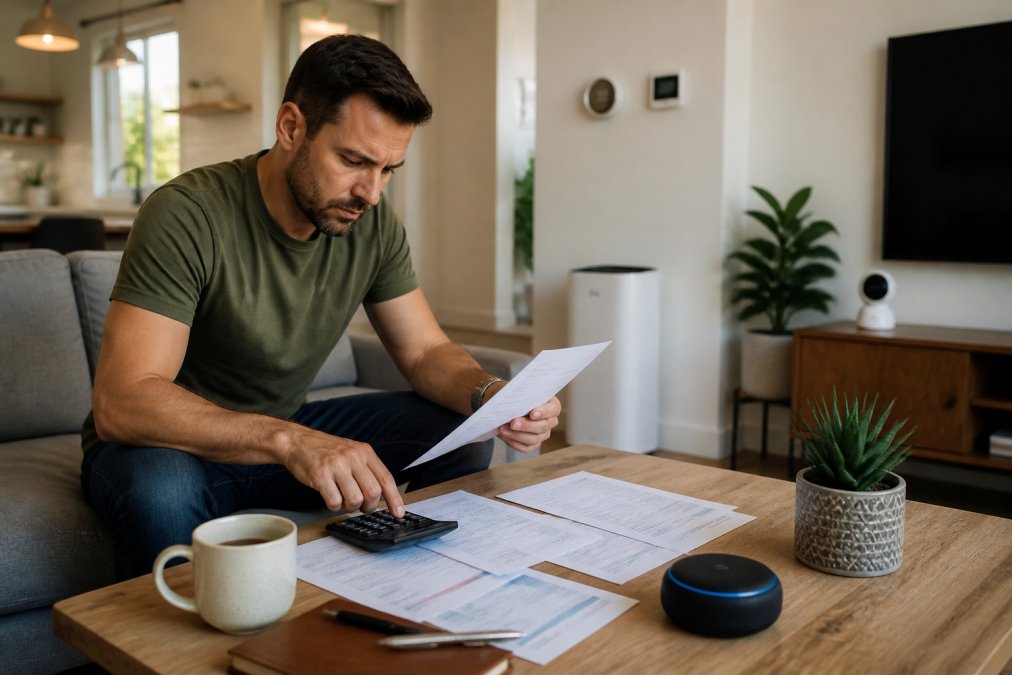
Smart thermostats in moderate climates generate $100-200 in annual savings, while the same device in harsh climates can save $300-400 annually. Installation costs range from $200-400 for DIY setups to $500-800 with professional installation, creating payback periods of two to six years depending on climate zone.
How to Calculate Your Own Payback Period
Gather your last 12 months of utility bills and calculate average monthly energy cost. Research the specific device you're considering and find credible estimates for energy savings, reducing manufacturer projections by 20-30% to account for real-world variations. Multiply your annual energy cost by the realistic savings percentage to get estimated annual savings. Divide the device cost (including installation) by annual savings to find the payback period in years.
Example: Your household spends $1,800 annually on heating and cooling. A smart thermostat manufacturer claims 15% savings. You reduce this to 12% based on actual user experiences. Annual savings: $1,800 × 0.12 = $216. Device cost with installation: $400. Payback period: $400 ÷ $216 = 1.85 years.
Real-World ROI Scenarios for Common Upgrades
A homeowner in Minneapolis with a gas furnace and heating bills of $1,200 annually installs a smart thermostat for $350. Realistic savings: $144-180 per year. Payback: 2-2.4 years. Over 15 years of home ownership, this generates $1,800-2,100 in net savings.
A homeowner in Phoenix with an air conditioning bill of $2,000 annually invests in a smart thermostat and smart blinds that close automatically during peak heat hours. Combined cost: $800. Realistic savings: $400-500 annually. Payback: 1.6-2 years.
| Upgrade Type | Typical Cost | Annual Savings | Payback Period | Best Climate |
|---|---|---|---|---|
| Smart thermostat | $400-800 | $150-400 | 2-5 years | Cold/hot extremes |
| LED lighting retrofit | $600-1,200 | $80-150 | 5-8 years | Any climate |
| Smart water heater | $500-1,500 | $100-200 | 5-10 years | Any climate |
| Low-flow fixtures | $200-600 | $50-120 | 2-8 years | High water cost areas |
| Smart power strips | $100-300 | $20-50 | 3-10 years | Any climate |
Energy-Efficient Home Improvements: Upfront Costs vs. Long-Term Savings
The tension between upfront investment and long-term savings defines whether sustainable home tech delivers real value. A $5,000 attic insulation project might save $400 annually in a moderate climate, suggesting a 12.5-year payback. But insulation doesn't degrade significantly over time, meaning that $400 in annual savings continues indefinitely. Passive improvements (insulation, air sealing, window upgrades) have longer payback periods but indefinite value once installed. Active devices (thermostats, smart controls, sensors) have shorter payback periods but require eventual replacement.
Smart Thermostats and HVAC Optimization
Smart thermostats represent the most reliable ROI in sustainable home tech because they address the largest energy expense in most households. HVAC systems consume 40-50% of residential energy in cold climates and 30-40% in hot climates. A device that reduces HVAC runtime by even 10% through intelligent scheduling generates substantial savings.
The technology works by learning your household's patterns and adjusting temperature automatically. When nobody is home, the thermostat raises cooling setpoints or lowers heating setpoints. When occupants return, it pre-conditions the home to comfortable temperatures just before arrival.
Installation costs vary significantly. A straightforward retrofit where existing wiring supports the new thermostat runs $200-400 including labor. Homes requiring new wiring can cost $800-1,200. Realistic annual savings range from $150-400 depending on climate severity and current HVAC system efficiency.
Smart Lighting and Automated Controls
LED lighting has become the standard because modern LEDs produce warm color temperatures indistinguishable from incandescent bulbs, last 15-25 years compared to 1-2 years for incandescent, and consume 75-80% less electricity for equivalent brightness.
A $2 LED bulb replacing a $0.50 incandescent bulb costs $1.50 more upfront. If the incandescent bulb uses 60 watts and the LED uses 9 watts, and electricity costs $0.12 per kilowatt-hour, the LED saves $0.62 annually. The bulb pays for itself in 2.4 years, then generates pure savings for the remaining 23 years of its life.
Motion sensors in bathrooms, hallways, and storage areas prevent unnecessary lighting in unoccupied spaces. These sensors cost $30-80 per unit installed and might save $30-50 annually. Payback periods fall between 1-2.5 years, making them a strong investment.
Water Conservation Technologies
Water conservation devices deliver more modest savings than energy efficiency upgrades in most areas because water costs less than electricity. However, in regions with high water rates or water scarcity concerns, the financial case improves significantly. Low-flow showerheads, faucet aerators, and toilet fill valve modifications cost $10-50 per fixture installed.
A low-flow showerhead reducing flow from 2.5 gallons per minute to 2.0 gallons per minute saves roughly 7,500 gallons annually per household member. At average water rates of $2-3 per 1,000 gallons, annual savings are $15-22 per showerhead. The device lasts 5-10 years, generating $75-220 in total savings.
The hidden benefit of water conservation is reduced hot water consumption, which directly reduces water heating energy costs. A showerhead reducing hot water usage by 20% simultaneously reduces the electricity or gas needed to heat that water.
Cost of Eco-Friendly Home Upgrades: Breaking Down the Numbers
The actual cost of eco-friendly upgrades extends far beyond the purchase price of devices or materials. Installation labor, permits, and integration with existing systems add 30-60% to material costs in most cases.
Renewable Energy Integration and Battery Storage
Solar photovoltaic systems range from $15,000-40,000 for residential installations depending on system size and local labor costs. A typical 6-kilowatt system costs $18,000-24,000 installed. The financial case depends critically on your utility rates, local solar irradiance, and available incentives. Homes in sunny regions with high electricity rates see payback periods of 6-10 years. Homes in cloudy regions with low electricity rates see payback periods exceeding 15 years.
Federal tax credits currently allow homeowners to deduct 30% of installation costs from federal income taxes, effectively reducing a $24,000 system cost to $16,800 out-of-pocket. State and local incentives vary widely but can further reduce costs by $2,000-5,000 depending on location.
Battery storage systems cost $10,000-15,000 installed and provide backup power during outages and the ability to shift consumption to lower-rate periods if your utility offers time-of-use pricing. Battery economics depend on specific utility rate structures and outage frequency.
Sustainable Building Materials and Insulation
Insulation improvements represent the most cost-effective passive energy efficiency upgrade in most climates. Adding insulation to an uninsulated attic costs $800-2,000 and reduces heating and cooling loads by 10-20% depending on climate severity. Annual savings range from $200-600, creating payback periods of 3-10 years.
The advantage of insulation is that it requires no maintenance, doesn't degrade significantly over decades, and provides indefinite value once installed. Unlike devices requiring replacement every 10-15 years, attic insulation installed in 2026 will still function identically in 2056.
Smart Home Energy Savings: Maintenance, E-Waste, and Device Longevity
The total cost of ownership for smart home devices extends well beyond purchase and installation price. Maintenance, eventual replacement, battery costs for wireless devices, and proper disposal of electronic waste add meaningful expenses over a device's lifetime.
Hidden Costs: Maintenance, Replacement, and E-Waste Lifecycle
Smart thermostats require no routine maintenance beyond occasional filter changes. However, if the device malfunctions, professional diagnostic and repair costs run $150-300. Most smart thermostats last 10-15 years, after which replacement becomes necessary.
Smart lighting systems require battery replacement for wireless controls and sensors every 2-5 years depending on usage. A whole-home lighting system with 20+ wireless devices might require $100-200 annually in battery replacements. Over 15 years, this accumulates to $1,500-3,000.
Electronic waste disposal is increasingly important as sustainability-conscious homeowners consider their full environmental impact. Budgeting $20-50 per device for responsible end-of-life recycling is prudent.
Compatibility and Interoperability Issues That Affect Total Cost
Smart home devices operate on different wireless protocols (WiFi, Zigbee, Z-Wave, Matter) and connect through different platforms (Amazon Alexa, Google Home, Apple HomeKit, Samsung SmartThings). A household that mixes devices from different ecosystems often discovers that some devices don't communicate properly, requiring the purchase of additional hubs or bridges.
A homeowner buying a smart thermostat compatible with Google Home, smart lights compatible with Amazon Alexa, and a smart lock compatible with Apple HomeKit might need to purchase three separate hubs ($100-300 total) to achieve basic home automation functionality. Standardization is improving with the adoption of Matter protocol, which enables cross-platform compatibility.
Environmental Impact and Carbon Footprint Benefits
Beyond financial ROI, sustainable home technology delivers environmental benefits that some households value independently of cost savings. A smart thermostat reducing HVAC runtime by 15% simultaneously reduces the carbon emissions associated with electricity generation or natural gas consumption. A household consuming 15,000 kilowatt-hours annually that reduces consumption by 15% eliminates roughly 3 tons of CO2 emissions annually.
Solar systems provide the most dramatic environmental benefit by replacing grid electricity with clean renewable energy. A 6-kilowatt solar system generating 8,000-9,000 kilowatt-hours annually eliminates 3-4 tons of CO2 emissions annually depending on local grid composition. Over a 25-year system lifespan, this accumulates to 75-100 tons of avoided emissions.
Water conservation devices reduce the energy required for water treatment, pumping, and heating, creating indirect carbon footprint benefits alongside direct water savings. Research from the U.S. Environmental Protection Agency's energy efficiency guidance emphasizes that residential energy efficiency represents one of the most cost-effective climate mitigation strategies available.
Evaluating Sustainable Home Tech for Your Situation
The decision to invest in sustainable home technology requires honest assessment of your specific circumstances. A smart thermostat makes perfect sense for a homeowner planning to stay 10+ years in a cold climate with high heating bills. The same device makes little sense for a renter or someone planning to move within three years.
Quick Assessment: Which Upgrades Make Financial Sense for You
Start by identifying your largest energy expenses. Review 12 months of utility bills and calculate the percentage breakdown: heating, cooling, water heating, lighting, and appliances. Focus sustainable home tech investments on the largest categories.
Next, calculate your local payback threshold. If you plan to stay in your home 8+ years, you can justify upgrades with 6-8 year payback periods. If you might move within 5 years, focus on upgrades with 2-3 year payback periods.
Research your local utility rates and climate zone. High electricity rates and extreme climates favor smart thermostats and insulation. Investigate available incentives, federal tax credits for solar, state rebates for smart thermostats, and utility company incentives can reduce your out-of-pocket costs by 20-40%.
| Your Situation | Best First Upgrade | Payback Period | Why It Works |
|---|---|---|---|
| Cold climate, high heating bills, planning to stay 10+ years | Smart thermostat + attic insulation | 2-5 years | HVAC is largest expense; passive improvement lasts indefinitely |
| Hot climate, high cooling bills, newer home | Smart thermostat + automated blinds | 2-3 years | AC dominates bills; combination approach maximizes savings |
| Any climate, low utility bills, renting | LED bulbs + power strips | 1-2 years | Low upfront cost; portable if you move |
| Sunny location, high electricity rates, planning long-term stay | Solar + battery storage | 8-12 years | Federal tax credits reduce cost; long-term ownership justifies investment |
| Water-scarce region, high water rates | Low-flow fixtures + smart irrigation | 2-4 years | Water costs more than in most regions; direct financial benefit |
Government Incentives, Tax Credits, and Rebates
The federal government currently offers a 30% tax credit for residential solar installations, reducing effective system cost by roughly $7,000-8,000 for a typical 6-kilowatt system. This credit applies through 2032. The U.S. Department of Energy maintains current information on federal solar tax credits for homeowners seeking to verify eligibility.
Many states offer additional solar incentives ranging from $1,000-3,000 depending on location. Utility companies frequently offer rebates for smart thermostat installation ($50-200), LED lighting upgrades ($1-2 per bulb), and insulation improvements ($300-500). Contact your utility company's energy efficiency program to identify available incentives.
The Bottom Line: Is Sustainable Home Tech Worth It?
The answer depends on three variables: your climate, your utility rates, and your timeline for remaining in your home. A homeowner in Minneapolis with high heating bills planning to stay 15+ years should absolutely invest in a smart thermostat and attic insulation. The same homeowner planning to move within two years should skip these investments and focus on portable improvements like LED bulbs.
The financial case for sustainable home technology is strongest for upgrades addressing your largest energy expenses with payback periods under five years. Smart thermostats in cold or hot climates, insulation in poorly insulated homes, and solar in sunny regions with high electricity rates all meet this criterion.
However, financial ROI isn't the only consideration. Environmental impact matters to many households. A smart thermostat eliminating 3 tons of annual carbon emissions provides genuine value even if the financial payback period stretches to six years.
ShopVerse.life offers carefully curated smart home devices and lighting solutions designed to help you implement these improvements effectively. Our [Wake Up Light Sunrise Alarm Clock](https://shopverse.life/products/wake-up-light-sunrise-alarm-clock-white-noise-sound-machine-bluetooth-speaker-color-changing-night-lights-for-bedroom-ideal-gift) at $51.54 demonstrates how quality smart lighting can enhance your daily routine while reducing energy consumption. For ambient lighting upgrades, our Modern LED Wall Sconce at $61.86 and Magnetic Rechargeable Wall Lamp at $52.98 provide energy-efficient alternatives to traditional fixtures.


Start your sustainable home tech evaluation by calculating your current energy expenses and identifying your largest consumption categories. Research specific upgrades addressing those categories, then verify payback periods using your local utility rates. Check available incentives before making purchasing decisions. By following this systematic approach, you'll invest in improvements that genuinely deliver financial returns alongside environmental benefits.
Frequently Asked Questions
Do smart home devices really save energy and money?
Smart home devices can reduce energy consumption by automating HVAC systems, lighting, and appliances, but actual savings depend on your current usage patterns and local utility rates. Smart thermostats typically save $10-15 monthly on heating/cooling costs, while smart lighting may save $5-10 monthly. The real question isn't whether they save energy, they do, but whether the upfront investment ($200-2,000+) pays back within your ownership timeline. Most devices break even in 3-7 years, making them worthwhile if you plan to stay in your home.
What's the average payback period for sustainable home tech upgrades?
Payback periods vary widely by technology and location. Smart thermostats typically pay back in 2-3 years; LED lighting retrofits in 1-2 years; solar panel systems in 6-12 years with federal tax credits; and water conservation fixtures in 2-4 years. Your payback period depends on current utility costs, climate, usage habits, and available incentives. Calculate your specific ROI using your actual utility bills and local energy rates rather than national averages, they often differ significantly.
How much does it cost to make a home energy efficient?
Energy-efficient home improvements range from $100-500 for smart plugs and LED bulbs to $15,000-50,000+ for solar panels or comprehensive thermal envelope upgrades. A typical mid-range retrofit (smart thermostat, LED lighting, weather sealing, and insulation improvements) costs $3,000-8,000. Start with low-cost, high-impact upgrades like thermostats and lighting, then evaluate larger investments like renewable energy. Federal tax credits and state rebates can offset 25-40% of costs for qualifying improvements.
What hidden costs should I consider before buying sustainable home tech?
Beyond the purchase price, budget for installation ($200-1,500 depending on complexity), ongoing maintenance (typically minimal but varies), potential replacement of incompatible devices, subscription fees for some smart home platforms ($5-20/month), and eventual e-waste recycling or replacement. Some devices require professional installation or integration with existing systems, adding unexpected costs. Research device compatibility with your current smart home ecosystem before purchasing to avoid costly replacements due to interoperability issues.
Are there government incentives or rebates for sustainable home upgrades?
Yes. The federal Inflation Reduction Act offers up to 30% tax credits for solar installations, heat pumps, and energy-efficient improvements through 2032. States and local utilities offer additional rebates, check DSIRE.org for your location. Energy Star certified products may qualify for rebates. Some utilities offer direct incentives for smart thermostat installation. These incentives can reduce your upfront costs by 25-40%, significantly improving ROI. Always verify current programs before purchasing, as incentives change annually.
This article was written using GrandRanker