

Manual vs Electric Vegetable Chopper for Meal Prep
Table of Contents
- Quick Comparison: Manual vs Electric Vegetable Choppers
- Manual vs Electric Vegetable Chopper for Meal Prep: Key Differences
- Durability and Build Quality: What Actually Lasts
- How to Clean Vegetable Choppers: Manual vs Electric
- Finding the Best Vegetable Chopper for Meal Prep
- Ergonomics, Accessibility, and Specific Vegetable Compatibility
- Long-Term Maintenance Costs and Environmental Impact
- Frequently Asked Questions
Last Updated: September 11, 2026
Quick Comparison: Manual vs Electric Vegetable Choppers
A manual vegetable chopper uses a pull cord, lever, or press to drive blades through food; an electric vegetable chopper uses a motor to spin or pulse blades. The trade-off is control and quiet operation versus speed and less effort.
For most meal prep routines, a manual chopper wins on cleanup, storage, and cost, while an electric model wins on volume and speed for larger batches. According to Love Great Finds' 2026 chopper testing, manual choppers cut prep time by 40% to 60% versus knife work, and Dioro's 2026 efficiency comparison puts that figure as high as 70%.
| Factor | Manual Chopper | Electric Chopper |
|---|---|---|
| Typical price | $15-$35 | $35-$120 |
| Cleanup time | 60-90 seconds | 2-3 minutes |
| Noise level | Silent | Motor hum |
| Best batch size | Small to medium | Large |
| Precision | High (manual control) | Moderate |
| Storage footprint | Compact | Bulky |
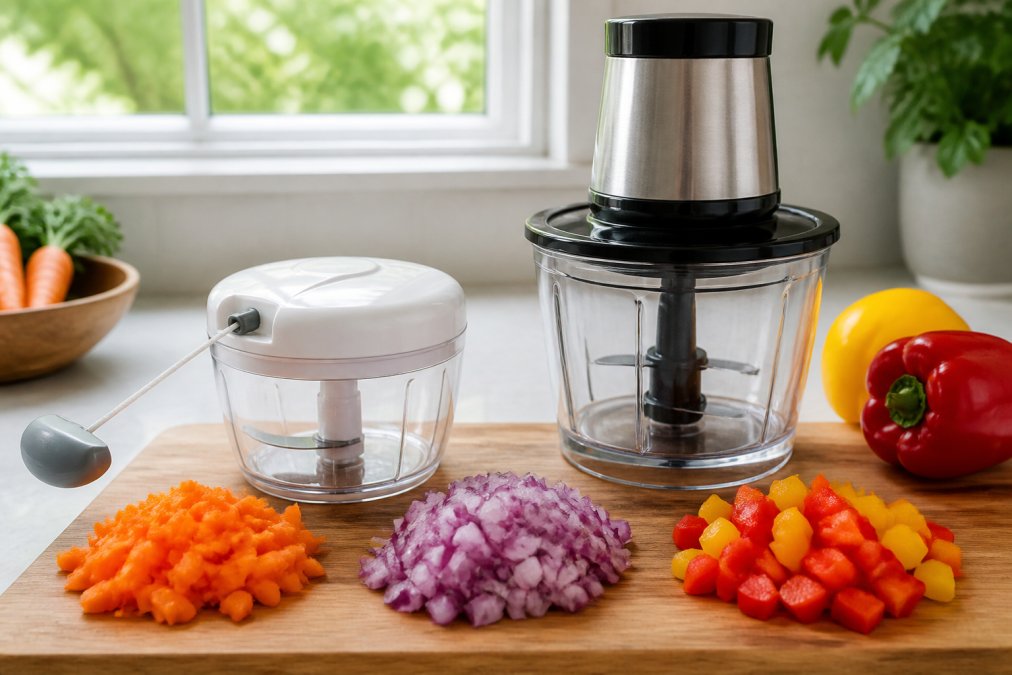
Manual vs Electric Vegetable Chopper for Meal Prep: Key Differences
The manual vs electric vegetable chopper for meal prep decision comes down to three variables: speed, control, and maintenance. Neither tool dominates across all three, so the "best" choice depends on how you cook.
Time Efficiency and Prep Speed
Electric choppers process large volumes faster because the motor works continuously. Manual choppers demand effort but still beat a knife by a wide margin. Manual models retail between $15 and $35, while electric models run $35 to $120, so the speed premium carries a real cost.
Chopping Precision and Texture Control
Manual choppers give you direct control over texture, which matters for mirepoix, salsa, and anything where uniform dicing or a coarse mince changes the dish. Alligator of Sweden's mechanism comparison found manual choppers deliver better precision and lower blade exposure because there's no motor overriding your input. Electric blades spin at a fixed rate, so you get consistency across a batch but less say over the final cut.
Durability and Build Quality: What Actually Lasts
Durability is where the category earns its bad reputation, and the failure modes are specific enough to predict before you buy. The New York Times Wirecutter tested 16 manual vegetable choppers and found significant durability issues across the board, with cracked containers and broken blades appearing during standard use (Wirecutter's manual chopper review(https://www.nytimes.com/wirecutter/reviews/best-manual-vegetable-choppers/)).
That finding condemns cheap manual choppers, not every one. Bargain units fail at three predictable points.
- The blade shaft. Thin stamped steel bends under repeated pressure from hard vegetables like carrots and beets. Once the shaft warps, the blade no longer seats flush and starts tearing rather than slicing.
- The lid hinge or press mechanism. Polypropylene hinges crack at the stress riser where the lid meets the pivot. This is the single most common warranty claim on pull-cord and press-style models.
- The container wall. Thin walls flex under load and develop hairline cracks near the base, which then leak.
Models with stainless steel blades (420 or 304 grade), a reinforced hinge, and thicker ABS or Tritan housings hold up for years. Electric choppers fail differently:
- The motor winding. Cheaper motors use aluminum windings that overheat and lose torque; copper windings tolerate repeated pulse cycles far better.
- The gearbox. Plastic gears strip when the blade jams on a fibrous vegetable. Metal or reinforced-nylon gears survive the same jam.
- The seal. A poor seal around the motor shaft lets liquid into the housing, which is the most common cause of premature electric chopper death.
Long-Term Maintenance Costs: The Angle Most Guides Skip
Most comparisons stop at the sticker price. The real cost of ownership lives in what happens after month six.
A manual chopper has no motor, cord, or electronics to fail. Its only ongoing cost is occasional blade replacement, and many models avoid even that with stainless steel blades that hold an edge for years. When one does fail, it's usually a single inexpensive part you can replace yourself.
Electric choppers carry a different cost curve. Motors wear out, cords fray at the strain relief, and replacement parts are often model-specific and hard to source once a model is discontinued. A common pattern is that the motor base outlives the bowl, or the bowl outlives the motor, and neither replacement is sold separately. That asymmetry is why the electric vegetable chopper market's projected growth from 325.0 in 2025 to 540.0 by 2035 (Market Research Future's chopper market report(https://www.marketresearchfuture.com/reports/electric-vegetable-chopper-market-41540)) translates into more models, more proprietary parts, and more e-waste over time.
| Maintenance Factor | Manual Chopper | Electric Chopper |
|---|---|---|
| Typical failure point | Blade shaft, hinge, container wall | Motor winding, gearbox, shaft seal |
| Ongoing cost | Blade replacement only | Motor and cord replacement |
| Replacement parts | Widely available, often universal | Often model-specific |
| Repairability | High (user-serviceable) | Low (sealed housings) |
| Lifespan | Years with care | Depends on motor quality |
| Energy use | None | Continuous while running |
| End-of-life waste | Minimal plastic | Motor, wiring, electronics |
How to Clean Vegetable Choppers: Manual vs Electric
Cleaning a manual vegetable chopper takes 60 to 90 seconds; cleaning an electric chopper takes 2 to 3 minutes, according to Love Great Finds' cleanup comparison. The gap comes down to part count. Manual models typically break into 3 to 5 dishwasher-safe components, while electric units add a motor housing that can never touch water.
Here's the practical cleaning routine for each:
- Manual: Separate the lid, blade assembly, and container. Rinse under warm water, then place dishwasher-safe parts on the top rack. Wipe the pull cord housing with a damp cloth.
- Electric: Remove the bowl and blade, wash both by hand or on the top rack, then wipe the motor base with a damp cloth. Never submerge the base.
The manual advantage is real but modest: 90 seconds per session, or roughly nine hours a year if you cook daily.
Finding the Best Vegetable Chopper for Meal Prep
The best vegetable chopper for meal prep matches your batch size and your patience for cleanup. There's no universal winner, and any guide claiming otherwise is selling something.
Use this decision framework:
- Cooking for one or two, chopping daily: Choose a manual chopper. Fast cleanup and a small storage footprint matter more than speed.
- Batch cooking for a family of four or more: Choose an electric chopper. The motor handles volume a pull cord can't sustain.
- Tight countertop space: Choose manual. Most manual units store flat in a drawer.
- Noise-sensitive household: Choose manual. Electric motors run loud enough to wake a sleeping child.
Cambom's 2026 buying guide notes that manual choppers are increasingly the preferred entry point for beginners because they're compact and can't suffer motor failure (Cambom's vegetable chopper guide(https://cambom.org/blog/buying-guides/best-vegetable-chopper)). That matches what we see: first-time buyers start manual, then add electric once their batch size grows.
If you're torn between the two, buy the manual chopper first. It costs a fraction of an electric model, and if you outgrow it, you'll know exactly what you need from a motorized unit.
Ergonomics, Accessibility, and Specific Vegetable Compatibility
Ergonomics is the most overlooked factor in this comparison, and it decides whether you actually use the tool. A manual chopper with a pull cord requires wrist and forearm strength, a stable grip, and hand endurance through a full batch. An electric chopper with a single pulse button demands far less physical labor per chop.
For anyone with arthritis, limited grip strength, or reduced mobility, that difference matters more than price or cleanup time. The relevant design features map directly to specific limitations:
- Suction base or non-slip feet. Keeps the unit locked to the counter so you're not fighting it mid-chop, which is the difference between one-handed operation and needing a second hand to steady the base.
- Large, low-resistance button or paddle. Reduces the finger force needed to trigger the motor, which matters for users with limited pinch strength.
- Ergonomic handle or wide grip surface. Reduces strain during repeated pulls or presses.
- Safety lock that engages with light pressure. Prevents the blade from engaging until the lid is sealed, without requiring a hard twist or firm press to release.
- Lightweight bowl and lid. A heavy glass bowl is stable but hard to lift and rinse; a lighter Tritan or polycarbonate bowl is easier to handle at the sink.
Vegetable Compatibility: Which Tool Handles What
Vegetable compatibility splits the two tools more sharply than most guides admit. The variable isn't just hardness; it's fiber content, water content, and how the blade engages the food.
| Vegetable | Manual Chopper | Electric Chopper | Notes |
|---|---|---|---|
| Carrots | Good | Good | Both handle firm root vegetables; manual needs a sharp blade and steady pressure |
| Onions | Good | Good | Manual gives more control over dice size; electric can turn onions to paste if pulsed too long |
| Bell peppers | Good | Good | Both work well; manual preserves cleaner edges |
| Potatoes | Fair | Good | Manual struggles with dense starch; electric pulse handles volume better |
| Beets | Fair | Good | Fibrous and staining; electric contains the mess better |
| Garlic | Good | Fair | Manual minces evenly; electric tends to puree |
| Herbs (cilantro, parsley) | Fair | Poor | Manual bruises less; electric blades chop herbs unevenly and can blacken them |
| Leafy greens | Poor | Fair | Manual tears leaves; electric can over-process into a slurry |
| Mushrooms | Fair | Fair | Both tend to crush rather than slice; a knife is often better |
| Zucchini / summer squash | Good | Fair | Manual holds texture; electric releases water and turns soft |
Manual choppers handle firm vegetables like carrots, onions, and bell peppers well but struggle with fibrous or watery items. Electric choppers with a pulse function manage tougher textures more evenly, though they can over-process soft vegetables into paste. The practical rule: manual for texture, electric for volume.
Long-Term Maintenance Costs and Environmental Impact
Long-term cost is where manual choppers pull ahead decisively. A manual unit has no motor, cord, or electronics to fail, so its only ongoing cost is occasional blade replacement, which many models avoid entirely with stainless steel blades that hold an edge for years.
Electric choppers carry higher lifetime costs. Motors wear out, cords fray, and replacement parts are often model-specific and hard to source. The electric vegetable chopper market is projected to grow from 325.0 in 2025 to 540.0 by 2035, according to Market Research Future's chopper market report(https://www.marketresearchfuture.com/reports/electric-vegetable-chopper-market-41540), which means more models, more parts, and more e-waste over time.
On environmental impact, manual choppers use zero electricity and generate far less end-of-life waste. No motor means no copper winding, no circuit board, and no cord to discard.
| Maintenance Factor | Manual Chopper | Electric Chopper |
|---|---|---|
| Ongoing cost | Blade replacement only | Motor and cord replacement |
| Replacement parts | Widely available | Often model-specific |
| Lifespan | Years with care | Depends on motor quality |
| Energy use | None | Continuous while running |
| End-of-life waste | Minimal plastic | Motor, wiring, electronics |
Choosing between a manual and electric vegetable chopper for meal prep is a question about how you cook, not which tool is objectively better. Manual models reward precision, quiet operation, and low maintenance; electric models reward speed and volume. If you want kitchen tools that match your routine, ShopVerse.life offers top-rated home and kitchen essentials with fast shipping, secure payment, and a money-back guarantee. Browse the collection and find the chopper that fits how you actually cook.
Frequently Asked Questions
Is an electric vegetable chopper worth it for meal prep?
It depends on your batch size and budget. Electric models range from $35 to $120 and handle large volumes quickly, but they take 2-3 minutes to clean and have motors that can fail. Manual choppers cost $15-$35, clean in 60-90 seconds, and never burn out a motor. If you prep small-to-medium batches a few times a week, a manual chopper is often the better value. For daily large-batch cooking, an electric model's speed may justify the higher cost and maintenance.
Are manual vegetable choppers safer to use than electric models?
Manual choppers generally offer better precision and lower blade exposure during operation compared to electric motors, according to Alligator of Sweden. The pull-cord or press mechanism keeps hands away from blades once the lid is locked. Electric choppers require careful handling during assembly and cleaning because the blades are sharper and the motor can start unexpectedly. Either way, always use the safety lock and never reach into the container while the blade assembly is installed.
Which vegetable chopper is better for large-batch meal prep?
Electric choppers win for large batches. They process several cups of vegetables in seconds and handle hard vegetables like carrots and sweet potatoes without manual strain. Manual choppers work well for small batches but can crack under heavy use; Wirecutter tested 16 manual models and found significant durability issues including cracked containers and broken blades. If you meal prep for a family or cook in bulk, an electric chopper with a pulse function and a large container capacity is the more reliable choice.
What should I look for when buying a vegetable chopper for meal prep?
Prioritize stainless steel blades, a sturdy container that resists cracking, and dishwasher-safe components. Manual choppers typically have 3-5 removable parts, which makes cleanup faster. Check for an ergonomic handle or pull cord if you have hand or wrist issues, and look for a suction base to keep the unit stable. Container capacity matters: a 4-cup model handles a mirepoix for two; a 10-cup model suits batch cooking. Skip plastic gears and thin lids, which are the first parts to fail.