

One Trustworthy Online Store for Home and Wellness Essentials
Table of Contents
- Why Managing Orders From Multiple Sites Costs You Time and Money
- Best Online Stores for Household Essentials: What Separates the Reliable From the Risky
- How to Vet Online Retailers for Security Before You Enter Your Card Details
- Benefits of One-Stop Shop Online Retailers for Home and Wellness Essentials
- Consolidation Logistics: How to Merge Scattered Orders Into One Supply Chain
- Inventory Overlap Analysis: Stop Buying Duplicates Across Sites
- Subscription Management Fatigue: When Recurring Orders Help and When They Hurt
- Conclusion: Building a Single, Trustworthy Shopping Routine
- Frequently Asked Questions
Last Updated: September 23, 2026
Why Managing Orders From Multiple Sites Costs You Time and Money
Juggling orders across several retailers quietly drains your time and your budget. The reason is simple: every extra site adds its own account, its own shipping fees, and its own delivery window, so a routine week of home and wellness essentials turns into a part-time job. This guide from ShopVerse.life breaks down how to find a single, trustworthy online store for home and wellness essentials, so you can stop managing orders from multiple sites.
The real cost isn't the products. It's the overhead.
- Separate checkout flows for daily staples, cleaning supplies, and personal care items
- Duplicate shipping charges that erase any per-item savings
- Multiple tracking numbers, support threads, and return policies to keep straight
Order consolidation fixes most of this. Instead of five small carts, one cart covers the week.
Best Online Stores for Household Essentials: What Separates the Reliable From the Risky
The most reliable online stores for household essentials share three traits: clear product sourcing, published return policies, and responsive support. Without those, low prices mean little.
When you compare options, score each retailer against the same criteria rather than chasing the cheapest listing. This is how you find the best online stores for household essentials without gambling on an unfamiliar seller.
| What to Check | Reliable Store | Risky Store |
|---|---|---|
| Product sourcing | Named suppliers, clear specs | Vague or missing details |
| Returns | Published, easy-to-find policy | Buried or unclear terms |
| Support | Live chat or phone, fast replies | Email-only, slow responses |
| Payment | Encrypted, recognized processors | Off-brand checkout pages |
| Reviews | Verified, specific feedback | Generic or duplicated praise |
A common mistake is treating a slick homepage as proof of trustworthiness. Design is cheap; a transparent return policy and reachable support team are not. Those are the signals that matter.
How to Vet Online Retailers for Security Before You Enter Your Card Details
Learning how to vet online retailers for security comes down to a short pre-purchase checklist, but the checklist only works if you understand why each item matters and what a failure actually signals. Run it once per site, and you'll never hand your card details to a questionable seller again.
Here's the checklist worth bookmarking, with the mechanism behind each line:
- Confirm the site uses HTTPS with a padlock in the address bar. HTTPS encrypts the connection between your browser and the server, so your card number can't be read in transit. It does not prove the seller is honest, a scam site can buy a certificate in minutes, so treat it as a floor, not a seal of approval.
- Check that checkout runs through a recognized payment processor. When checkout hands off to a major card network or a well-known payment processor, the transaction inherits that processor's fraud protections and dispute process. If checkout asks you to type card details into a custom form on an unfamiliar domain, that's the single biggest red flag.
- Read the return and refund policy in full before buying. Look specifically for the return window (in days), who pays return shipping, and whether refunds go back to the original payment method or only to store credit. Store-credit-only policies quietly lock your money into a store you may not want to use again.
- Verify a physical business address or contact page exists. A real street address and a working phone number give you a legal entity to pursue if something goes wrong. A contact form with no address is a dead end.
- Search the brand name plus "reviews" and skim for patterns. Ignore one-off complaints, every retailer has them. Look for repeated patterns: the same missing-order story, the same "refund never arrived" story, the same "support stopped responding" story across multiple reviewers.
- Test support with one question before placing a large order. Send a specific question ("Does this ship from a US warehouse? What's the return window on this item?") and time the response. Fast, specific answers predict how a problem will be handled later; vague or slow answers predict the opposite.
The Federal Trade Commission's online shopping guidance outlines your rights when an order never arrives or arrives damaged, and knowing them changes how you shop. Under the FTC's Mail, Internet, or Telephone Order Merchandise Rule, a seller generally must ship within the time promised (or within 30 days if no time is stated) and must offer a refund if it can't (the FTC). That rule is your leverage when a store goes quiet.
A common pattern is that people vet the product and skip vetting the seller. They read 40 reviews of a blender and zero reviews of the store selling it. Flip that ratio. The product is replaceable; a bad seller can cost you the money, the time, and the dispute.
If a retailer can't pass this checklist, no discount justifies the risk. The cost of a failed order isn't just the refund you may never see, it's the hours spent chasing support, the re-order, and the gap in your household supply while you wait.
Benefits of One-Stop Shop Online Retailers for Home and Wellness Essentials
The core benefit of one-stop shop online retailers is consolidation: one account, one checkout, one delivery window for everything from kitchen basics to wellness products. That single change removes the daily friction of tracking scattered orders.
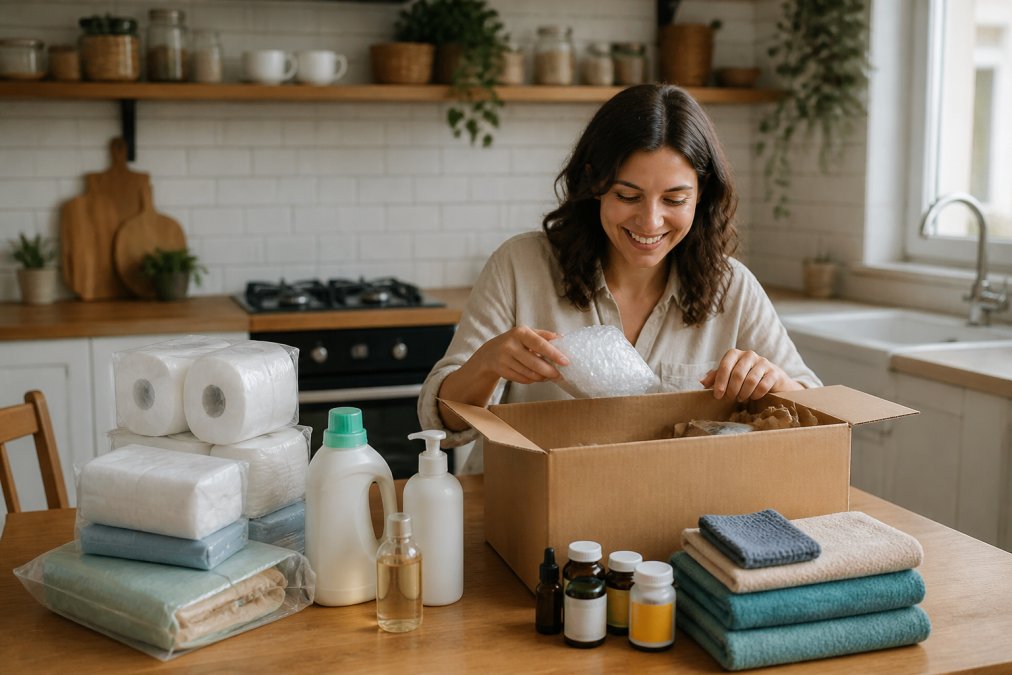
But the deeper benefit, the one most listicles skip, is that consolidation is a logistics problem, not a shopping problem.
1. One shipping threshold instead of five. Most retailers waive shipping above a minimum order. When you split a $120 week across four stores, you may pay shipping four times because no single cart clears the threshold. Consolidating into one cart lets you clear that threshold once, and the savings compound every week.
A single store also makes it easier to keep a running household inventory, spot when you're low on daily staples, and reorder before you run out. That's the habit layer on top of the logistics layer, and it only works when the purchasing lives in one place.
Consolidation Logistics: How to Merge Scattered Orders Into One Supply Chain
Consolidation logistics is the practice of combining purchases from several sources into one recurring supply chain. It sounds basic, but the execution is where most people slip back into old habits.
Start by grouping what you buy into three buckets:
- Daily staples: consumables you replace weekly or monthly
- Durable goods: items you buy once or twice a year
- Wellness and personal care: recurring health and self-care products
Inventory Overlap Analysis: Stop Buying Duplicates Across Sites
Inventory overlap analysis means checking what you already own across every site before you buy again. Most households unknowingly stock two or three of the same item because each retailer's order history lives in a separate silo.
Run a simple audit once a quarter:
- Pull your order history from each store you use
- List items you've bought more than once in the same period
- Flag anything still unopened or barely used
- Move those items to a single reorder list going forward
Subscription Management Fatigue: When Recurring Orders Help and When They Hurt
Subscription management fatigue is the point where recurring orders stop saving time and start costing money. It happens when you sign up for too many auto-ship plans and lose track of what's arriving when.
Conclusion: Building a Single, Trustworthy Shopping Routine
The challenge isn't finding products. It's building one routine you can trust so you stop juggling five carts and five delivery windows.
Frequently Asked Questions
What criteria should I use to evaluate the trustworthiness of an online store?
Check for a secure checkout (HTTPS and a visible padlock), a clear return and money-back policy, a physical business address, and responsive customer support you can reach before buying. Look for verified reviews on independent platforms, not just testimonials on the store's own site. A trustworthy store for home and wellness essentials will also list product sourcing details and let you contact support with pre-purchase questions. If a site hides its return policy or only offers chatbot support, treat that as a warning sign.
How can I consolidate my household and wellness shopping into one platform?
Start by listing everything you currently buy across multiple sites each month, from cleaning supplies to supplements. Group those items by category, then identify which ones a single retailer can cover. Move the highest-frequency items first, such as daily staples and personal care products, and keep a backup source only for specialty items. Setting a recurring order schedule for predictable purchases reduces the number of separate checkouts and makes it easier to track spending in one place.
What security features should I look for when shopping at a new online store?
Look for SSL encryption on every page, especially checkout, and payment options that tokenize your card details so the retailer never stores your full number. Two-factor authentication on your account adds another layer. Check whether the site uses a recognized payment processor and whether it clearly states its privacy policy. Avoid saving card details on unfamiliar sites. If the store offers guest checkout, that limits how much personal data stays on file.
How do I know the products at a new online retailer are authentic and not knockoffs?
Check whether the retailer lists brand authorization or sourcing information for the brands it carries. Look for serial numbers, warranty registration, and manufacturer packaging on electronics and wellness products. Read reviews that mention product authenticity specifically, not just shipping speed. A curated store that vets its suppliers will typically publish brand partnerships or quality assurance details. If a price seems far below the manufacturer's listed price, that is a red flag worth investigating before you buy.