

Does a Standing Desk Help With Weight Loss? What Science Says
Table of Contents
- The Real Story Behind Standing Desk Weight Loss
- Calories Burned Standing vs Sitting: What the Numbers Show
- How Long to Stand at a Desk for Weight Loss Results
- Best Practices for Standing Desks: A Beginner's Transition Protocol
- Health Benefits Beyond Weight Loss: Metabolic and Cardiovascular Gains
- Why Standing Desks Alone Won't Melt Pounds Away
- Building a Movement-Friendly Workspace with ShopVerse.life
- Frequently Asked Questions
Last Updated: September 10, 2026
The Real Story Behind Standing Desk Weight Loss
Does a standing desk help with weight loss? The honest answer is that it helps modestly, and only as part of a broader movement strategy. Standing burns roughly 50 to 100 more calories per hour than sitting, according to evidence-based analysis of standing desk calorie burn, and workers who alternate positions may add about 170 calories per day to their energy expenditure.
Those numbers matter, but they are not a diet.
Standing desk weight loss is best understood as a metabolic nudge rather than a fat-burning switch. The research backs the framing that the desk changes how much you move, not how much you eat. A workplace intervention study on sit-stand desks found that significant reductions in sedentary time held steady over 24 weeks, which is the real win here.
Below, we break down the calorie math, the standing-to-sitting ratios that work, and where the "desk as weight loss tool" narrative falls apart.
Calories Burned Standing vs Sitting: What the Numbers Show
The gap between standing and sitting is real but smaller than most marketing suggests. Standing for 180 minutes after lunch reduced blood sugar spikes by 43% compared to sitting, per research on post-meal standing and glucose, a finding from a small study of 10 office workers.
Here is how the calorie comparison shakes out:
| Activity | Calories Burned (per hour, approx.) | Daily Impact |
|---|---|---|
| Sitting at a desk | Baseline | Reference point |
| Standing at a desk | 50-100 more | ~170 extra/day |
| Alternating 50/50 | Varies | ~8,640 extra/year |
That annual figure comes from annualized standing desk calorie projections, and it assumes you actually use the standing function half the time. Most people don't, at least not at first.
Why NEAT Is the Hidden Variable in Daily Energy Expenditure
NEAT (non-exercise activity thermogenesis) is the energy your body burns through everyday movement that isn't formal exercise, including standing, fidgeting, walking to the kitchen, and shifting your weight while you work. It's the mechanism that makes standing desks relevant to weight management at all.
The practical implication: a desk that gets you standing 3 hours a day beats a desk that gets you standing 30 minutes, even if the second desk costs twice as much. Consistency in micro-movements matters more than any single feature.
How Long to Stand at a Desk for Weight Loss Results
The recommended starting point is 30 minutes of standing per hour of desk work, building toward a 1:1 or 2:1 sit-to-stand ratio over several weeks. Jumping straight to all-day standing is the fastest route to sore feet and abandoned habits.
A realistic progression:
- Week 1-2: 15-20 minutes standing per hour
- Week 3-4: 30 minutes standing per hour
- Week 5-8: Alternate full hours, sit one, stand one
- Ongoing: Target 50% of your workday on your feet
The NIH-backed study on sustained sedentary reduction showed participants maintained reduced sitting time across 24 weeks, which suggests slow transitions stick better than aggressive ones.
Best Practices for Standing Desks: A Beginner's Transition Protocol
Good ergonomics decide whether your standing habit survives past week two. The setup matters more than the desk itself, and the transition schedule matters more than both. Most people who abandon a sit-stand desk do so because they jumped to full-day standing in the first week, then blamed the desk for the sore feet and aching lower back that followed.
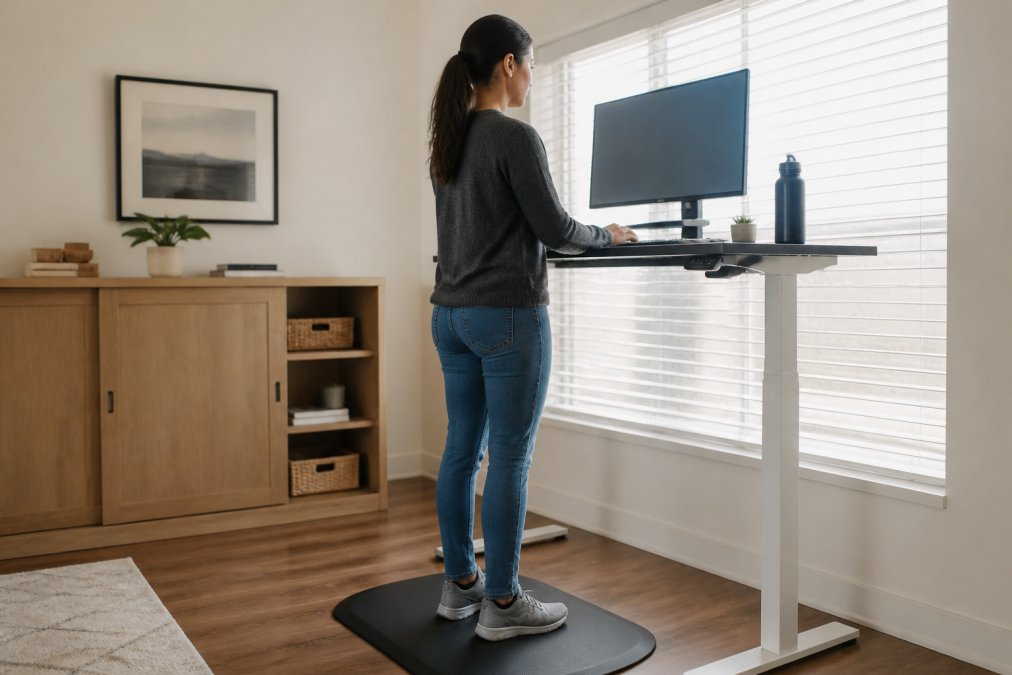
Start with these non-negotiables before you stand for a single minute:
- Monitor top edge at or slightly below eye level
- Elbows bent at roughly 90 degrees when typing
- Wrists flat, not angled up or down
- Anti-fatigue mat underfoot for cushioning
- Supportive shoes, not socks or bare feet
- Water bottle within reach to prompt movement breaks
A Four-Week Onboarding Schedule That Actually Sticks
A common pattern among people who successfully adopt a sit-stand routine is a gradual ramp rather than a hard switch. Here is a four-week structure that most beginners can tolerate without foot or back pain:
Week 1, Acclimation (15-20 minutes standing per hour) Stand for the first 15 minutes of each hour, then sit for the remaining 45. The goal is not calorie burn; it is letting your feet, calves, and lower back adapt to a new load. Expect mild calf tightness by day three. That is normal.
Week 2, Extension (25-30 minutes standing per hour) Push the standing block to roughly half of each hour. If your feet ache by mid-afternoon, drop back to Week 1 for two days rather than pushing through.
Week 3, Alternating hours (stand one hour, sit one hour) Move from minute-level intervals to full-hour blocks. This is where most people report the habit starting to feel automatic. Use a timer or a desk-reminder app for the first few days.
Week 4, Stabilization (target 50% of the workday on your feet) Aim for four standing hours across an eight-hour day, split into blocks no longer than 90 minutes. Beyond 90 minutes without a seated or walking break, most people start shifting weight from one leg to the other, a sign the position has stopped being productive.
Troubleshooting the Three Most Common Failure Points
Foot and heel pain. Usually a mat problem, not a standing problem. A flat, thin mat does almost nothing. Look for a mat with at least ¾ inch of cushioning and a beveled edge so you can shift your stance. If pain persists past two weeks, reduce standing time by half and rebuild.
Lower back fatigue. Almost always a monitor-height issue. When the screen sits too low, you lean forward and load your lumbar spine. Raise the monitor until the top edge is at or just below eye level, and keep the keyboard close enough that your elbows stay near 90 degrees. science-backed weight loss supplements.
Habit collapse around week three. The novelty fades before the routine is automatic. The fix is anchoring: tie your standing blocks to fixed events, the first meeting of the day, the post-lunch hour, the afternoon slump, rather than to willpower. Anchored habits survive; willpower-based ones usually do not.
Ergonomic Setup: Posture, Monitor Height, and Anti-Fatigue Mats
Spinal alignment and joint strain are the two things beginners ignore. A monitor placed too low forces your neck forward; standing on a hard floor for two hours loads your knees and lower back.
A common mistake is buying the desk first and the mat last, or skipping the mat entirely. The mat is what makes hour three possible. Pair it with a footrest for alternating leg positions and you'll stand longer without noticing. If you wear hard-soled dress shoes, keep a pair of supportive sneakers at the desk and swap into them for standing blocks.
Health Benefits Beyond Weight Loss: Metabolic and Cardiovascular Gains
Weight loss is the weakest argument for a standing desk. The stronger case is metabolic and cardiovascular health.
Standing after meals supports better glucose levels and insulin sensitivity, which matters for chronic disease prevention independent of any weight change. Reduced sedentary behavior is linked to improved cardiovascular health markers and lower obesity risk over time, and the evidence review on standing desk health outcomes notes that cardiometabolic improvements show up even when the scale doesn't move.
Energy levels and productivity tend to improve too, though the effect varies by person and task type.
Why Standing Desks Alone Won't Melt Pounds Away
Standing desks do not cause meaningful weight loss on their own, and any source claiming otherwise is overselling. Harvard Health and Houston Methodist researchers have been direct about this: a standing desk won't replace diet or structured exercise. But the reason it won't is more interesting than the conclusion, and understanding the mechanism is what separates a useful desk purchase from a wasted one.
The math explains part of it. Burning an extra 170 calories per day adds up to roughly 62,000 calories a year, or about 17 pounds in theory. In practice, most people unconsciously compensate by eating slightly more or moving less elsewhere. The body resists easy deficits.
The Compensation Mechanism Nobody Explains
Three things quietly erase the calorie math:
1. Post-standing appetite signaling. Standing increases sympathetic nervous system activity, which can nudge appetite upward. A common pattern is finishing a two-hour standing block and feeling hungrier than a comparable seated stretch, then reaching for a snack that more than offsets the 100-200 calories the standing block burned. This is the single biggest reason standing desks underdeliver on weight loss, and almost no article addresses it.
2. NEAT adaptation. Non-exercise activity thermogenesis is not a fixed budget. When you add standing to your day, your body often reduces other low-level movement, fewer trips to the kitchen, less fidgeting while seated, shorter walks, to keep total daily energy expenditure roughly stable. The desk doesn't add to your movement total so much as reshuffle it, unless you deliberately protect the other movement.
3. The 'I earned it' effect. Behavioral research on exercise compensation shows that people who believe they've been active tend to eat more and move less afterward. A standing desk can trigger the same psychology: the perception of effort outpaces the actual energy cost.
What Actually Makes the Desk Work
The desk earns its place as a lifestyle intervention that supports weight management rather than driving it, but only when it's paired with the things that do drive it.
- Structured exercise. Resistance training two to three times per week preserves lean mass during a calorie deficit, which is what makes any weight loss stick. The desk does not substitute for this.
- Deliberate movement breaks. A two-minute walk every hour beats a two-hour standing block for total energy expenditure, because walking burns more per minute than static standing and breaks up the sedentary pattern that standing alone does not fully address.
- Protein-forward meals. Higher protein intake blunts the post-standing appetite spike and protects muscle. This is the practical counter to compensation.
- A modest calorie deficit. The desk can contribute 100-200 calories a day to that deficit. It cannot create one on its own.
Building a Movement-Friendly Workspace with ShopVerse.life
A desk alone won't build the habit. The supporting equipment does.

For a home setup that encourages movement between standing blocks, a few additions make a real difference. The Abdominal Wheel Ab Roller at $23.86 gives you a two-minute core break between meetings without leaving the room. The 6-Tube Resistance Band Set at $52.26 covers strength work in the same footprint as your chair.
For targeted core work during seated stretches, the Smart EMS Abdominal Trainer at $38.00 and the Rechargeable Body Slimming Waist Belt at $40.54 round out a home routine that fits around a workday.


ShopVerse.life curates these picks with the same standard across electronics, home goods, and wellness, backed by secure payment, fast shipping, and a money-back guarantee.
Frequently Asked Questions
How many calories do you burn standing at a desk vs sitting?
Standing burns roughly 50 to 100 more calories per hour than sitting, according to a 2024 review of standing desk research. Over a full workday, that can add up to about 170 extra calories. One analysis estimates that spending half your workday standing could burn 8,640 additional calories per year. The exact number depends on your body weight, movement during standing, and how often you shift positions.
How long should you stand at a desk to see weight loss results?
Start with 30 minutes of standing for every hour of sitting and gradually build toward a 1:1 or 2:1 sit-stand ratio. Research shows sedentary time drops significantly when people use sit-stand desks consistently over 24 weeks. There is no fixed threshold for weight loss, but the longer and more regularly you stand, the more calories you expend. Pair standing with walking breaks and structured exercise for measurable results.
Does using a standing desk count as exercise?
No. Standing is classified as light activity, not exercise. It raises your non-exercise activity thermogenesis (NEAT), the energy you burn through daily movement, but it does not replace cardiovascular or strength training. Experts at Harvard Health and Houston Methodist note that standing desks should not be viewed as a substitute for diet or structured workouts. Think of a standing desk as one piece of a broader active lifestyle.
What are the best practices for standing desks to avoid pain?
Set your monitor at eye level, keep elbows at a 90-degree angle, and use an anti-fatigue mat. Alternate between sitting and standing every 30 to 60 minutes. Wear supportive shoes and avoid locking your knees. A 2021 NIH study found that sit-stand desk users maintained reduced sedentary time over 24 weeks without reported harm. If you feel joint strain, shorten your standing intervals and increase them gradually.
The challenge with any standing desk is that the habit fades without the right support around it. ShopVerse.life stocks the equipment that keeps a movement-friendly workspace functional: curated premium picks, 24/7 online support, and a money-back guarantee if something doesn't fit your routine. Get started with ShopVerse.life and build a home office that actually keeps you on your feet.