

Ergonomic Office Chairs for Men Over 6 Feet
Table of Contents
- Why Standard Chairs Fall Short for Men Over 6 Feet
- Ergonomic Chair Seat Depth Requirements for Tall Users
- How to Measure for an Ergonomic Office Chair
- Critical Dimensions: Seat Height, Backrest Height, and Adjustment Range
- Big and Tall Office Chair Weight Capacity and Frame Durability
- Adjustable Features That Matter: Lumbar Support, Armrests, and Headrests
- What to Prioritize Over Price When Choosing an Ergonomic Office Chair
- Frequently Asked Questions
Last Updated: September 3, 2026
Over 60% of office workers experience posture-related discomfort, and for men over 6 feet tall, the problem is far more acute. Standard office furniture isn't designed for your body. Most ergonomic office chairs for men over 6 feet fall short because they prioritize average-height users, leaving taller professionals with inadequate lumbar support, insufficient seat depth, and backrest heights that don't reach the middle of their spine. This guide from ShopVerse.life breaks down the exact specifications you need to evaluate when choosing an ergonomic office chair tall men can actually use for eight hours without pain.
The stakes are higher than comfort. According to Fortune Business Insights research on workplace ergonomics, over 70% of organizations in the United States provide ergonomic seating solutions to employees specifically to enhance productivity and reduce workplace injuries. Yet most tall professionals still end up in chairs designed for bodies five to six inches shorter than theirs. The result: chronic back pain, neck strain, and lost productivity.
We'll walk you through the critical dimensions that separate a chair that works from one that leaves you hunched and aching by 3 p.m.
Why Standard Chairs Fall Short for Men Over 6 Feet
Standard office chairs simply aren't engineered for taller bodies. Most standard office chairs accommodate heights up to about 5 feet 10 inches, according to Office Logix Shop's guide to tall ergonomic seating. When you're 6'2" or taller, you're working against furniture designed for someone six inches shorter.
The problem compounds across three dimensions. First, seat height rarely adjusts high enough. Second, standard chairs typically offer a seat depth of 16 to 18 inches, which is often insufficient for users with long femurs. This leaves 2 to 4 inches of your thigh unsupported, creating pressure points and forcing your weight onto the back of your knees. Third, backrest heights top out around 24 inches, leaving the upper-middle portion of your back without support.
The ergonomic office chair for men over 6 feet market has grown precisely because standard furniture fails this population. According to Grand View Research's ergonomic chair market analysis, the global ergonomic chair market is projected to grow from $12.4 billion in 2026 to $16.8 billion by 2030. Tall-specific demand is driving much of that growth.
Ergonomic Chair Seat Depth Requirements for Tall Users
Seat depth is the most underestimated dimension when evaluating an ergonomic office chair for men over 6 feet. This is where most tall users experience immediate relief or immediate regret.
A proper seat depth should be 20 to 22 inches for anyone over 6 feet. Your thighs need full support from hip to knee without pressure on the back of your knees. When you sit in a chair with insufficient depth, your weight concentrates on a smaller area, creating a pressure point that cuts off circulation and causes discomfort within 30 minutes.
Test this yourself: sit in the chair and ensure you can slide three fingers between the edge of the seat and the back of your knee. If you can't, the seat is too shallow. If your thighs hang unsupported, that's a non-starter.
Seat width matters too. You want at least 20 inches of usable width so you're not sitting on the edge. Wider seats also distribute weight more evenly, reducing pressure on your sit bones.
How to Measure for an Ergonomic Office Chair
Before you buy, measure your body and your workspace. This prevents costly mistakes.
Start with your inseam. Stand barefoot with your back against a wall. Measure from the floor to the top of your hip bone. This tells you roughly how high your seat needs to be. As a general rule, your seat height should be approximately 0.3 times your inseam, plus an inch for shoe thickness. If your inseam is 34 inches, you'll need a seat height of roughly 21 to 22 inches.
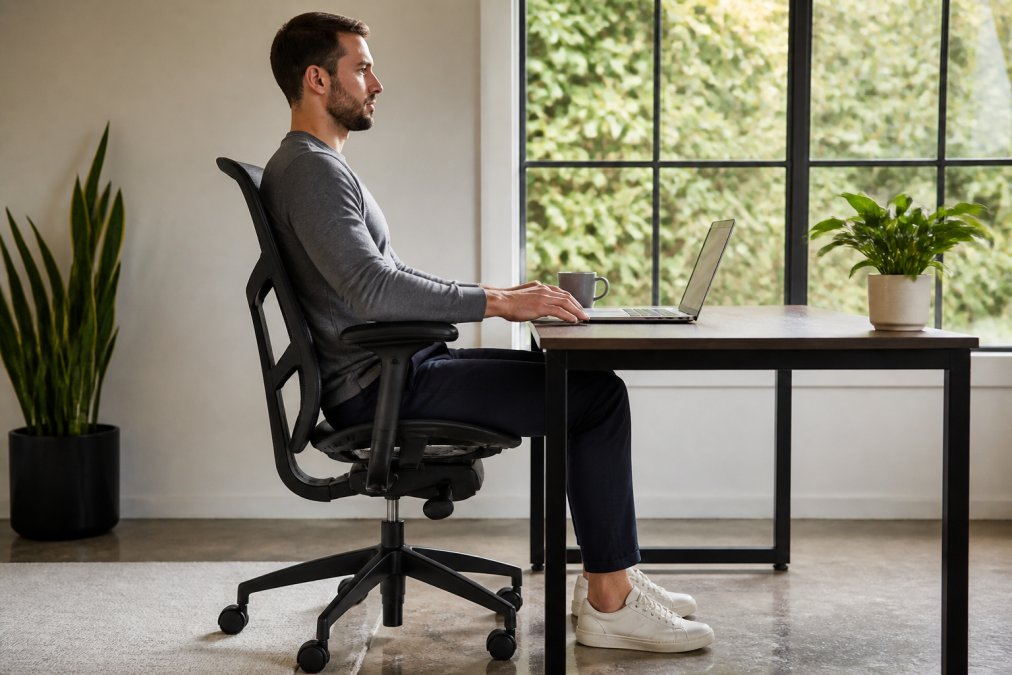
Next, measure your torso length from your sitting surface to the top of your shoulders. This determines the backrest height you need. Most tall users need a backrest that extends at least 26 to 28 inches from the seat. Standard chairs max out around 24 inches.
Check your desk height too. Your elbows should rest at a 90-degree angle when your hands are on the keyboard. If your desk is standard height (29 to 30 inches) and your seat needs to be 21 inches high, you're working with a 9-inch gap. That's tight. An adjustable desk that goes up to 31 or 32 inches gives you more flexibility.
Finally, measure the distance from your hip to your knee. This is your seat depth requirement. Most tall men need 20 to 22 inches. If you have exceptionally long thighs, 22 to 24 inches is ideal.
Write these numbers down. They become your non-negotiables when evaluating chairs.
Critical Dimensions: Seat Height, Backrest Height, and Adjustment Range
The ergonomic office chair for men over 6 feet must deliver on three core dimensions: seat height range, backrest height, and lumbar support vertical adjustment.
Seat height range is where most tall men get disappointed. Standard ergonomic chairs offer a height adjustment range of 16 to 21 inches. For someone 6'2" or taller, that's insufficient. You need a minimum range of 18 to 24 inches, ideally 18 to 26 inches. This gives you flexibility whether you're sitting at a standard desk or a raised one.
Backrest height is non-negotiable. Your backrest should extend from the seat to at least the mid-back, ideally to the lower-shoulder blades. For most tall men, this means a backrest of 26 to 30 inches. Anything less leaves your upper back unsupported, forcing your shoulders forward and creating neck strain by mid-afternoon.
Lumbar support vertical adjustment is the feature that separates a good tall-specific chair from a mediocre one. Standard chairs have fixed lumbar support that works fine for average-height users. For tall men, you need at least 6 inches of vertical adjustment on the lumbar support so you can position it exactly where your lower back needs it. Your lumbar curve doesn't start where an average person's does.
Test these ranges in person if possible. Sit in the chair at your maximum recommended height and minimum height. Your feet should touch the floor comfortably at both extremes. Recline slightly and check that lumbar support follows your spine, not a generic curve.
Big and Tall Office Chair Weight Capacity and Frame Durability
Weight capacity matters less than frame durability when you're tall. A 6'4", 190-pound man doesn't need a 500-pound capacity chair. What he needs is a frame engineered to handle the stress that height and use place on the base.
Tall users create different stress patterns. Your weight is distributed over a longer lever arm. The gas cylinder works harder. The base experiences more rotational stress. A chair rated for 300 pounds but engineered for average height may fail faster than a 400-pound capacity chair designed with tall users in mind.
Look for chairs certified to BIFMA X5.11, which is the standard for heavy-duty office seating. This certification tests durability and safety across multiple dimensions, including the stress patterns tall users create. A BIFMA X5.11 certified chair has been tested to withstand the kind of use you'll put it through.
Frame material matters. Steel frames with reinforced welds outperform aluminum frames for tall users. Check whether the base is a five-star design (five wheels, wider stance) rather than a four-star base. A wider base distributes weight more evenly and prevents the wobble some tall users experience in standard chairs.
The gas cylinder is critical. A tall user's weight and the longer sitting surface create more downward force on the pneumatic lift. A quality cylinder from a reputable manufacturer (Stabilus, for example) will maintain its pressure longer than a generic one. Some chairs offer dual cylinders for added durability, though this is rare.
Adjustable Features That Matter: Lumbar Support, Armrests, and Headrests
Adjustability separates a chair you tolerate from one you actually prefer.
Lumbar support should offer both vertical and horizontal adjustment. Vertical adjustment lets you move the support pad up or down to match your spine's curve. Horizontal adjustment (depth) lets you control how much the pad protrudes into your back. For tall men, this dual adjustment is essential because your lumbar curve sits at a different height than average-height users.
Armrests should be 4D adjustable: height, width, depth, and angle. Standard fixed armrests are useless if your proportions don't match the designer's assumptions. With 4D adjustment, you can position the armrests so your elbows rest at 90 degrees without shrugging your shoulders. This eliminates neck and shoulder strain.
Headrest positioning is often overlooked but critical for tall users. Your head sits higher than the designer expected. A fixed headrest at standard height either misses your head entirely or forces your chin down at an uncomfortable angle. Look for a headrest that adjusts both height and angle. Some chairs offer a headrest that tilts backward to support your head during recline, which is valuable if you take breaks during the day.
A reclining mechanism with adjustable tilt tension lets you lean back without feeling like you're going to flip. For tall men, a synchro-tilt mechanism (where the seat and backrest move together) is superior to a standard tilt because it maintains your hip angle while allowing recline.
What to Prioritize Over Price When Choosing an Ergonomic Office Chair
The cheapest ergonomic office chair for men over 6 feet is never the best value. Price and quality diverge sharply in this category.
Prioritize adjustability over aesthetics. A plain black chair with extensive adjustment options will serve you better than a stylish chair with limited customization. You'll spend 40+ hours per week in this chair. Comfort compounds over time.
Prioritize durability over trendy materials. Mesh backrests are popular because they look modern and breathe well. For tall users, a high-density foam backrest with a breathable mesh covering often provides better support. The foam maintains its shape under the stress tall users create, while the mesh prevents heat buildup.
Prioritize proven design over novelty. Chairs that have been on the market for three to five years have real user feedback. New designs may look innovative but lack long-term durability data. Check reviews specifically from users over 6 feet tall, not average reviews.
Prioritize base stability over weight capacity. A 300-pound capacity chair with a reinforced base and five-star footprint will outlast a 500-pound chair with a standard base. Tall users don't need excessive weight capacity; they need a base that handles the use their height creates.
ShopVerse.life curates ergonomic seating specifically for professionals who need more than standard office furniture offers. Our selection focuses on chairs engineered for tall users, not generic "big and tall" designs. We verify adjustability ranges, test durability, and prioritize real-world comfort over marketing claims.
| Feature | Why It Matters for Tall Users | Minimum Specification |
|---|---|---|
| Seat Height Range | Must accommodate 21-26" without compromising posture | 18-26 inches |
| Backrest Height | Provides support to mid-back and lower shoulders | 26-30 inches |
| Seat Depth | Prevents thigh pressure and supports full leg length | 20-22 inches |
| Lumbar Adjustment | Positions support at your spine's natural curve | 6+ inches vertical |
| Armrest Adjustment | Eliminates shoulder strain and neck tension | 4D adjustable |
| Base Design | Prevents wobble under tall user use | 5-star, 28"+ diameter |
Choosing an ergonomic office chair for men over 6 feet requires specificity. You can't rely on standard recommendations or generic "best of" lists. Your body imposes different demands on a chair than average-height users face, and furniture designed for the average won't solve your problem. At ShopVerse.life, we help you find chairs engineered specifically for your proportions, with the adjustability and durability tall professionals need. Get started with our curated selection of tall-specific ergonomic seating and experience the difference a properly fitted chair makes to your productivity and health.
Frequently Asked Questions
What is the best ergonomic office chair for a man over 6 feet tall?
The best ergonomic office chair for tall men combines seat height adjustment to at least 20-22 inches, a backrest height of 24-30 inches, and seat depth of 19-22 inches. Look for chairs with adjustable lumbar support, a pneumatic cylinder rated for extended height ranges, and a reinforced frame. Features like adjustable headrests and 4D armrests further enhance comfort for taller users. Prioritize adjustability over fixed features, as individual torso length and leg proportions vary significantly.
How does seat depth affect comfort for tall users?
Seat depth is critical for tall users because standard chairs typically offer only 16-18 inches of depth, leaving 2-4 inches of the thigh unsupported. This creates pressure points and poor posture. Tall users need 19-22 inches of depth to ensure proper weight distribution across the entire thigh. Some chairs offer adjustable seat pans that slide forward or backward, allowing you to customize depth to your femur length and sitting position preferences.
What is the difference between big and tall office chairs?
Big and tall chairs address different ergonomic needs. Big chairs prioritize weight capacity and frame reinforcement for heavier users. Tall chairs focus on extended seat height ranges, deeper seat pans, taller backrests, and longer pneumatic cylinders to accommodate greater height and torso length. Tall users often mistakenly buy heavy-duty 'big and tall' chairs, paying for weight capacity they don't need while missing height-specific features like extended backrest height and deep seat pans that actually improve comfort.
How much should you spend on an ergonomic chair for long-term back health?
While budget matters, investing in a chair with proper lumbar support, seat depth, and adjustability reduces the risk of chronic back pain and neck strain. A quality ergonomic chair can help prevent costly health issues and improve daily comfort during the 8+ hours you spend sitting.
This article was written using GrandRanker