

Build a Minimalist Home Office: A 2026 Guide
Table of Contents
- Why a Minimalist Home Office Matters for Productivity
- Choose the Right Space and Define Your Workspace Area
- Best Ergonomic Gadgets for Remote Work
- Declutter and Simplify Your Work Environment
- Cable Management Solutions for Home Office
- Minimalist Desk Setup Ideas with Neutral Colors and Natural Light
- Maintain Your Minimalist Office Long-Term
- Conclusion
Last Updated: August 18, 2026
Why a Minimalist Home Office Matters for Productivity
A minimalist home office isn't about having almost nothing, it's about keeping only what drives results. According to research from malife (2026), messy desks slow task completion by 10%, while decluttering can boost productivity by up to 77%. That gap isn't small. It's the difference between finishing your day energized or burned out.
The science backs this up. When your brain processes visual clutter, it diverts cognitive resources away from the work itself. Princeton University research on visual processing and clutter shows that even when you try to ignore surrounding distractions, your brain still processes the blurred background, overwhelming the frontal cortex and impairing performance. This isn't about aesthetics. It's about neuroscience.
Here's what matters most: 54% of people feel overwhelmed by their belongings, and the average person spends 2.5 days per year searching for misplaced items (IPMI Blog, 2024). That's nearly a full workweek lost to chaos. Organized spaces lower stress hormones by 27% (malife, 2026), which means a minimalist home office isn't just more productive, it's healthier.
At ShopVerse.life, we've helped thousands of remote workers transform their spaces by focusing on this principle: keep only what serves your work, remove everything else.
Choose the Right Space and Define Your Workspace Area
Location determines whether your minimalist home office works or fails. Rooms with solid doors and distance from household activity centers reduce distractions by 60-70%. This isn't negotiable. If your office is in a high-traffic area, you're fighting physics.
Start by assessing what you have. A functional home office requires a minimum of 80 square feet, though 120-150 square feet allows proper separation between work and living zones. If you have less space, you'll need to be more ruthless about what stays on your desk surface.
Define the boundary clearly. Your workspace area should have visual and physical separation from the rest of your home. This could be a dedicated room, a corner with a room divider, or even a specific desk orientation that faces away from living spaces. The psychological boundary matters as much as the physical one.
Consider lighting placement before choosing your location. Natural light from a window is ideal, but position your desk perpendicular to the window, not facing it directly, which causes glare, and not with your back to it, which creates shadows on your work surface. If natural light isn't available, you'll need task lighting positioned above and slightly behind your monitor.
The minimalist approach to space planning means no unnecessary furniture. A desk, chair, and storage are the essentials. Everything else is clutter waiting to happen.
Best Ergonomic Gadgets for Remote Work
Your body will spend 40+ hours per week in this space. Ergonomics aren't optional, they're foundational to a sustainable minimalist home office setup.
Start with the chair. An ergonomic chair supports your lower back, keeps your feet flat on the floor, and allows your arms to rest at 90 degrees when typing. This isn't luxury, it's injury prevention. Poor posture compounds over months, leading to chronic pain that destroys productivity.
Next, the desk. Height-adjustable desks have become standard in 2026 for good reason: alternating between sitting and standing throughout the workday reduces back pain, improves circulation, and increases energy levels (Rackora, 2026). A minimalist approach means one quality desk over multiple cheap ones. Look for clean lines and a simple surface without built-in storage that encourages clutter.
Monitor positioning matters more than most people realize. Your monitor should be at eye level, about 20-26 inches away. If you use a laptop, add an external monitor and keyboard to achieve proper positioning. This single change prevents neck strain that accumulates silently.
Lighting deserves its own category. Task lighting positioned above your desk reduces eye strain and improves focus. The best setups use both task lighting and ambient lighting, task for work, ambient for the overall room. Warm minimalism, the 2026 design trend, emphasizes warm-toned lighting over harsh white light, which reduces fatigue during long work sessions.
Cable management tools aren't glamorous, but they're essential to maintaining a clean desk surface. Cable sleeves, clips, and organizers keep cords hidden and prevent the visual chaos that undermines minimalism. This is where most people fail, they create a clean desk, then let cables multiply underneath until the whole system collapses.
Declutter and Simplify Your Work Environment
This is where most people struggle. Decluttering isn't a one-time event, it's a decision-making process.
Start by removing everything from your workspace that isn't directly related to work. Office supplies, personal items, decorations, all of it goes into a separate area. Then, bring back only what you actually use weekly. According to the IPMI Blog (2024), 80% of items people keep are never used. Your workspace should be in the 20%.
Evaluate each item against one question: Does this help me work better? If the answer is no, it leaves. This includes desk accessories, decorative items, and equipment you think you might use someday. "Might" is the enemy of minimalism.
Create zones for what stays. A minimalist desk has three zones: the active work area (clear), the secondary area (supplies you use daily), and storage (everything else, hidden). This three-zone system keeps your desk surface clean while maintaining access to what you need.
Paper is the biggest culprit. Minimize paper by scanning documents and storing them digitally. If you must keep paper, use a single filing system, not multiple stacks and piles. Digital minimalism extends to your physical space: fewer papers mean fewer visual distractions.
Cable Management Solutions for Home Office
Visible cables destroy the minimalist aesthetic and create mental clutter. Hidden cables are the difference between a professional workspace and a tangled mess.
Use cable sleeves to bundle cords together. These fabric or plastic tubes contain multiple cables in a single, clean line running along the back or underside of your desk. The visual impact is dramatic, what looked chaotic now looks intentional.
Cable clips and adhesive organizers route cables along desk edges and walls, keeping them out of sight. Position clips every 12-18 inches to prevent sagging. This takes 20 minutes and transforms your workspace.
Behind the desk, use a cable management box or tray to corral power strips and adapters. This single change hides the most visible source of cable chaos. Label each cable at both ends so you know what connects where, essential if you ever need to unplug something.
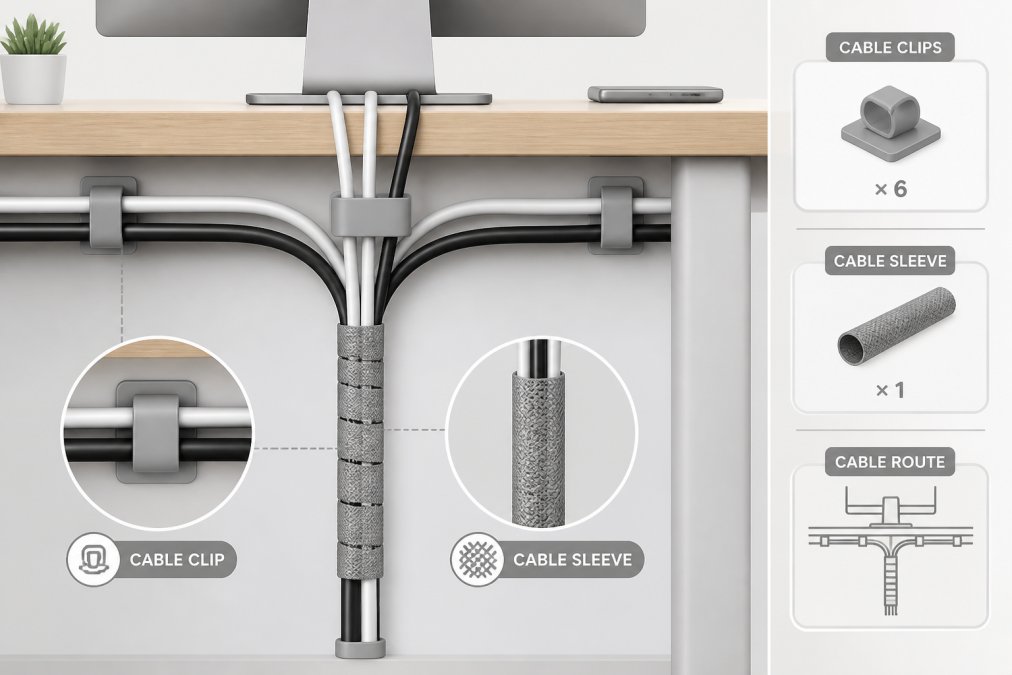
Wireless options reduce cable count. A wireless mouse, keyboard, and headphones eliminate three major cable sources. The trade-off is battery management, but the visual payoff is worth it.
The minimalist approach to cables means no "just in case" cords. If you're not using it, it doesn't live in your office. Spare cables go into a labeled box in storage, not coiled under your desk.
Minimalist Desk Setup Ideas with Neutral Colors and Natural Light
Your desk surface is the visual anchor of your minimalist home office. A cluttered desk undermines everything else you've done.
Start with the desk itself. Natural wood in warm tones, ash, walnut, or oak, aligns with the 2026 trend of warm minimalism, which replaces stark whites and grays with warmer neutrals, natural wood, and tactile fabrics (Quartz, 2026). A simple wooden desk with clean lines costs less than a complex one and looks better empty.
Surface color matters. Light neutrals (warm white, light gray, natural wood) expand the visual space and reduce eye strain. Dark surfaces can feel heavy and create visual weight even when empty.
Limit desk accessories to essentials. A monitor, keyboard, mouse, and one pen holder. That's it. Everything else, notepads, staplers, decorative items, lives in drawers or off the desk. The best remote work setup in 2026 is described as "intentional," prioritizing one great monitor over a cluttered multi-screen setup (The Guy Corner NYC, 2026).
Natural light is non-negotiable. Position your desk to maximize daylight without glare. If your desk faces a window, add a diffuser or sheer curtain to soften harsh light. If your desk has its back to the window, you get natural light without glare, ideal.
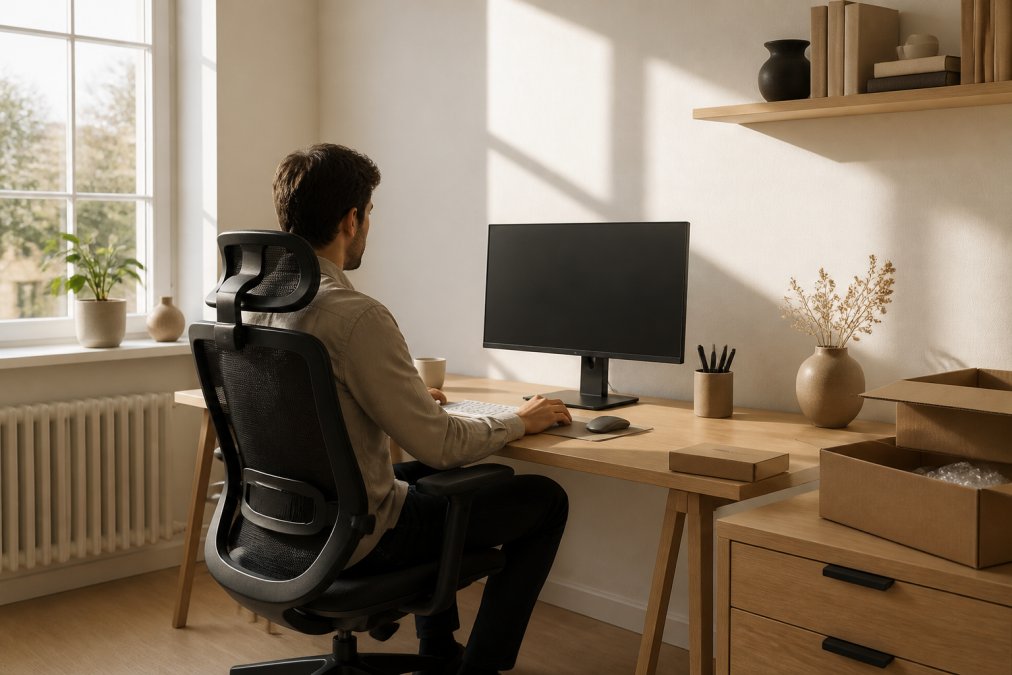
Add one small element of visual interest, a single plant, a simple clock, or a piece of art. Not for clutter, but for humanity. A completely sterile space can feel cold and demotivating. The key is restraint: one item, not five.

Minimalist luxury, the 2026 evolution of minimalism, prioritizes premium materials, flawless finishes, and intuitive design, with a defining characteristic being "invisible tech" (seamless integration of power supplies, data ports, and structural supports). This means cable management that's so clean you don't see it, storage that blends into the desk, and technology that disappears into the background.
| Element | Minimalist Approach | Why It Matters |
|---|---|---|
| Desk Surface | Clear except monitor, keyboard, mouse | Reduces visual noise and decision fatigue |
| Lighting | Natural + one task light | Improves focus and reduces eye strain |
| Color Palette | Warm neutrals (wood, cream, soft gray) | Creates calm without feeling sterile |
| Accessories | One item maximum | Maintains visual clarity |
| Cables | Hidden behind desk or in sleeves | Eliminates visual clutter |
Maintain Your Minimalist Office Long-Term
Creating a minimalist home office is one thing. Keeping it that way is another. Most people revert to clutter within 3-6 months without a maintenance system.
The key is a weekly reset. Every Friday, spend 15 minutes returning items to their designated spaces. This prevents the gradual creep of clutter that happens when you're busy. A small amount of maintenance beats a massive decluttering project every six months.
Implement a "one in, one out" rule. If you bring a new item into your office, something else leaves. This prevents accumulation while allowing your space to evolve.
Digital minimalism extends to your physical space. Unsubscribe from catalogs, avoid impulse purchases, and resist the urge to "just keep this for now." Each item you don't bring in is one less thing you'll need to manage later.
Quarterly audits catch drift. Every three months, evaluate your desk and storage. Does everything still serve your work? If not, remove it. This prevents the slow return to chaos that undermines productivity gains.
Track how you feel in your space. A minimalist home office should feel calming and focused. If it starts feeling chaotic again, that's your signal to audit and reset. Your environment is feedback, listen to it.
Conclusion
Building a minimalist home office isn't about deprivation. It's about removing the friction between you and your best work. The research is clear: organized spaces boost productivity by up to 77%, lower stress, and improve focus. Over 58% of knowledge workers now operate in hybrid or fully remote arrangements (Rackora, 2026), making workspace design a competitive advantage.
ShopVerse.life offers curated, high-quality products designed specifically for minimalist home offices, from ergonomic chairs to cable management solutions to warm-neutral desk accessories. Our carefully selected collection includes everything you need to build a focused, professional workspace without the clutter. With 100% secure payment, fast shipping, and a money-back guarantee, you can confidently invest in pieces that actually serve your work. ShopVerse.life's curated home office collection makes it simple to find exactly what you need in one place.
Frequently Asked Questions
What are the essentials for a minimalist home office?
A minimalist home office requires an ergonomic chair, a functional desk, adequate lighting (natural and task), storage solutions that hide clutter, and cable management tools. Research shows 78% of workers believe a tidy environment enhances focus. Start with these core items and add only what directly supports your work. Avoid decorative pieces that don't serve a purpose, every item should earn its place in your workspace.
How do I organize my minimalist desk setup ideas to reduce distractions?
Organize by function: keep only active work items on your desk surface, use vertical storage for supplies, and implement cable management to eliminate visual noise. Rooms with solid doors and distance from household activity centers reduce distractions by 60-70%. Use drawer organizers or concealed storage to maintain a clean desk. The goal is a workspace where your eyes land only on what you need right now, not on clutter or cables.
Can a minimalist home office actually improve productivity?
Yes. Decluttering can boost productivity by up to 77%, and organized spaces lower stress hormones by 27%. A messy desk slows task completion by 10%. When your environment is clean and intentional, your brain uses less energy processing visual distractions and can focus on work. Americans spend an average of 2.5 days each year searching for misplaced items, minimalism eliminates that waste.
What's the best color palette for a minimalist workspace?
Warm minimalism is the 2026 trend: replace stark whites and grays with warmer neutrals like beige, soft gray, and natural wood tones. Add tactile fabrics and materials like solid wood rather than veneer. This approach maintains the clean, distraction-free aesthetic of minimalism while creating a calming, human-centered space that doesn't feel cold or sterile. Pair neutral walls with natural light for maximum psychological benefit.
This article was written using GrandRanker